We approach this turquoise bedroom as a field report rather than a decoration project, recording how repeated, deliberate choices build a daily sanctuary. The space feels open and quietly purposeful, its calm derived not from neutrality alone but from the careful curation of colour, texture and light. The seafoam walls soften daylight rather than compete with it, while the white paneled bed frame acts as a disciplined anchor that keeps the room legible at a glance. Nightstands, lamps and a trio of botanical prints are positioned with surgical simplicity, each element reinforcing the others without leaping for attention. The textiles do the heavy lifting: a weighty white quilt anchors the bed; cushions in teal and pale green add depth; a rug with leafy hints grounds the floor. We test combinations, moving cushions, examining shadows, and retreating to the doorframe to assess from different distances. The result is not a showpiece but a practical language for daily living: a room that expands or contracts with the day, while remaining reliable and reassuring. We note that the architecture, high ceilings, clean cornice, wide windows, provides the structure that allows a restrained palette to feel generous. The framed leaves above the bed feel like a quiet sermon on nature rather than a loud statement about taste. In this report, we map how light, line and texture converge to create a space that invites slow mornings, focused work and restful evenings without demanding effort from its occupant. Finally, we consider how this design would adapt to different climates and times of year, confirming its durability and its capacity to support a lived life rooted in patience and habit.
Foundations of colour and light
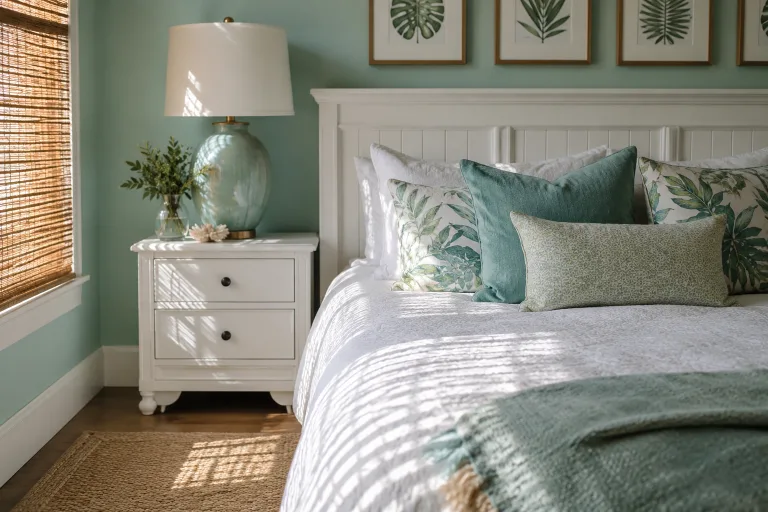
Colour is a quiet conversation in this space. The seafoam walls do not shout; they greet daylight with a soft whisper, opening the room to a gentler scale. We observe how the white bed frame and nightstands act as bright anchors, drawing the eye toward the headboard where framed botanical prints sit in neat succession. The crown moulding provides a crisp boundary between wall and ceiling, preventing the colour from flattening the room or turning clinical. The room benefits from the window's long, unobstructed sill, offering a place to rest objects that the eye can digest without distraction. The palette's logic is simple: white plus seafoam equals clarity, teal adds depth, and lime accents appear only as soft punctuation; this keeps the surface area in balance while giving the space a sense of air and ease.
Light moves across the space with a predictable rhythm: morning light travels from east to west, catching the quilt's stitching first, then the leaf-pattern cushions, then the prints. In the early hours, the room reads as pale and cool, while by late afternoon the teal softens to a warmer tone, the whites glow with a pearly sheen, and the textures reveal themselves in more tactile detail. The ceiling's height helps the light to be forgiving; even at its brightest, the room remains restful rather than radiant, a place for quiet operations and slow mornings.
 Save
Save
The window is a sculpture in glass and wood, a vertical frame through which daylight travels at a human pace. We observe the way a thin shade pattern on the quilt emerges as the sun slides; the shadows become a second embroidery on the fabric. The space invites you to pause at the threshold and listen for the hush of air moving through the room, as if the space itself were breathing slowly. In this tone of gentleness, we find a rule: colour is a tool for listening rather than shouting, and light is a guide to action rather than a spectacle.
Textile language and tactile rhythm
Textiles carry the room's mood as carefully as the paint on the walls. The quilted duvet is substantial, a counterpoint to the knit of the cushions, both lying in the same tonal family yet offering different textures under the hand. Botanical motifs on the cushions echo the framed leaves above the bed, but their colour is deeper, a whisper rather than a shout. The throw at the foot of the bed adds another layer of pattern, a subtle nod to movement without interrupting the harmony. The rug beneath is not merely decorative; it is a tactile footprint that invites bare feet to anchor themselves to the floor and feel the room's rhythm beneath the body.
And yet we are always mindful of scale. The textiles claim space on the bed but do not overpower; the cushions number four, then five with the added lumbar, then back to four as we adjust for a quieter moment. We test the fabric's response to sunlight: white cotton brightens; the teal weave takes on a slightly cooler cast; the linen's natural texture catches the light and reveals subtle irregularities that speak of handcraft and patience. The result is a layered surface that rewards close inspection and still reads at a distance as a single, cohesive field of colour and texture. This is not maximalism; it is measured abundance, designed to comfort the body and steady the eye.
 Save
Save
We choreograph the textiles with seasons in mind, never letting one layer grow so dominant that it stuns the senses. The cushions are arranged in a quiet order: two larger square cushions that anchor the shoulders of the bed, two smaller rectangles that pull the eye in toward the centre, and a slender lumbar pillow to bridge the line of the quilt. The weave of the throws changes with daylight: a slightly rougher texture catches the morning rays and glows softly in the afternoon, inviting hands to linger and fingers to seek relief in fibre and colour.
Furnishings as still-life
Furnishings in this space are chosen for their sculptural presence and their quiet utility. The bed headboard frames the room; its panels align with the window mullions, creating a vertical rhythm that keeps the eye moving slowly. The nightstands are slim, with drawers that hold the small necessities of a morning routine, and the ceramic lamps with pale teal glaze sit on their tops as anchors for the evening. Above the bed, the trio of framed leaves forms a calm gallery, the sizes carefully varied and the spacing meticulously measured to keep the wall from feeling crowded. Each object speaks softly to its neighbour, never competing, always supporting a sense of calm.
 Save
Save
We notice how the furniture's finish plays with light. The white paint has a chalky undertone that absorbs glare, while the lamps' ceramic bases reflect a gentle glow that softens the edges of the cushions. The bed's headboard's moulding catches a thin line of shadow at dusk, paling the whiteness into a creamy ambient tone. The room's architecture teaches restraint: a few precise pieces, functional and well-made, can carry the entire design without shouting in the wrong place. The upshot is not a showroom; it is a room where one can sit, breathe, and consider the day ahead with measured calm.
Careful accessories and daily rituals
Accessories are kept minimal, chosen for touch rather than display. A small teal ceramic jar on the bedside table offers storage for a single ring or a loose coin, while a linen sampler folded at the back of the chair invites a tactile pause. The framed leaves above the bed are proof of restraint; their repetition across the wall keeps the feeling cohesive. We test the effect of adding or removing a single item and observe how the space shifts from restful to slightly staged; the goal remains to keep the room honest, unpretentious, and usable. The rituals of daily care, changing the sheets, adjusting the cushions and lighting a lamp, become the true measures of the room's health.
We conclude that the space thrives on a disciplined routine: white surfaces stay bright, textiles stay generous but not excessive, and light remains central to mood. The space rewards slow attention: a longer look reveals the connection between the leaf prints and the quilt's stitching; a longer touch confirms the quality of the fabrics and their restraint. We do not chase novelty here; we chase endurance, the durability of a look that can travel through seasons without losing its centre. The final impression is one of quiet confidence, a room that can accommodate early morning tasks, late-night reading, and the gentle passage of time without fatigue.
How to do it
Identify the core palette
Select a base of white and seafoam, then introduce teal as the unifying accent. Keep lime as a small supportive note for depth.
Layer textiles with restraint
Choose a crisp quilt, botanical cushions, and a patterned rug that share tonal values. Avoid competing prints; let texture carry the contrast.
Arrange for light and flow
Place the bed to expose the headboard to the main wall and ensure shutters can modulate daylight without creating glare on the textiles.
Maintain timeless care
Regularly rotate cushions, launder textiles on a cool cycle, and vacuum the rug to preserve the gentle colour balance.
Frequently asked
What makes this turquoise bedroom feel calm rather than loud?
Which materials are essential for this look?
How can a small room avoid feeling cramped with these colours?
What typifies botanical textiles in this space?
Are there budget-friendly swaps for this look?
How do you maintain the colour balance over time?
What role do light fixtures play here?
In closing
In this field report we have traced a deliberate sequence of choices that translate a colour story into daily life. The balance of seafoam and white yields serenity, while the botanical accents keep the room from feeling sterile. By respecting proportion, texture and light, we have crafted a space that invites slow presence rather than quick admiring glances. The architectural framework supports restraint, making the room endure through changing seasons and daily rhythms. The exercises of layering textiles, calibrating light, and placing objects with intention become repeatable habits that can guide future renovations. The final impression is of a room that remains legible and comforting, even as new habits, tasks and routines enter the occupant's life. This turquoise bedroom demonstrates that durable calm comes from small, faithful decisions, one day at a time.