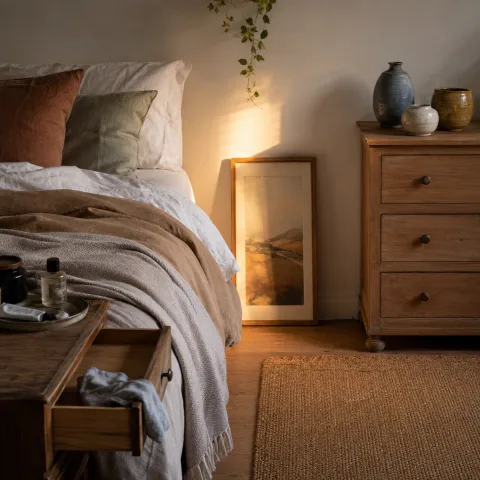
The sugar bowl arrived with the thrift shop sticker still on its base. It’s an overfired blue, dim where the glaze pooled, with a diagonal hairline crack we sealed with clear nail polish years ago. On slow mornings I move it under the lamp, set a single spoon inside, and for a minute the dresser looks edited instead of cluttered. We don’t keep many objects on the bedroom surface, but the three ceramics we do keep — each small, slightly imperfect, and chosen for a different use — make the space feel deliberate.
Why three, and why ceramics
Three feels like a small set that still reads as intentional. One holds something living (a stem or a tiny branch), one is strictly useful (a bowl for hairpins or sugar), and one is for incidental items that don’t deserve their own drawer (a ring, a key, a scuffed lighter). Ceramics, unlike glass or metal, look warm in low light and tolerate knocks — a scuff becomes character, a glaze crazing reads like texture instead of damage.
 Save
Save
The three pieces we rotate
- The squat sugar bowl: shallow, with a lid that squeaks if you slide it. Holds tiny things and reads like a deliberate object on a nightstand.
- The small bud vase: often pressure-crazed, never perfectly straight. It takes one stem — a dried poppy, a thrifted eucalyptus shoot — and makes it feel like a composition.
- The little catch-all ashtray: the right depth for rings and coins; heavy enough that it stays put and forgiving of fingerprints.
 Save
Save
“We keep objects that can be picked up and used without thinking.” — Mira
How we choose at the thrift shop
We don’t buy because something is old or cheap; we buy because it will be used. In the shop I test the base for wobble, check rims for sharp chips and lift it to feel the weight. A lightweight vase that tips with a single stem is a no. A heavy, slightly awkward lid that still fits is a yes. Color matters less than temperature — a matte, warm glaze reads nicer at night than a bright, shiny white that glares under the bedside lamp.
 Save
Save
- Test the base: lift and set it down; feel for wobble.
- Look for hairline cracks along rims — they widen with washing.
- Pick pieces with a purpose: don’t buy a dozen vases; buy one that will be used.
- Favor pieces with a forgiving glaze and a shape that sits low and steady.
How to do it
Select a sturdy base piece
At the thrift shop, lift the ceramic and set it back down twice — if it wobbles or tilts, leave it. Choose something with a flat, heavy base that won’t shift on the dresser.
Test the lid and rim
If the object has a lid, open and close it a few times; check the rim for hairline cracks by running a thumbnail around the edge. Prioritize pieces that feel like they were made to last.
Remove stickers and wash gently
Soak in warm water with a splash of dish soap, then wipe remaining sticky residue with a little oil. Avoid scouring pads; use a soft cloth to preserve the glaze.
Decide each piece’s purpose
Assign roles — vase, catch-all, or functional bowl — and keep that role consistent for at least a month so the object becomes part of the room’s rhythm.
Frequently asked
Are thrifted ceramics safe to use for food or drink?
How do you mend a hairline crack?
What if a piece smells musty?
How often should you rotate the pieces?
In closing
Choose pieces that tolerate being touched, moved and occasionally knocked. Keep the rotation small — three items at most — and let them earn their place by being useful or beautiful. In our apartment the rule is simple: fewer things, thoughtfully used, and the bedroom stays calm.