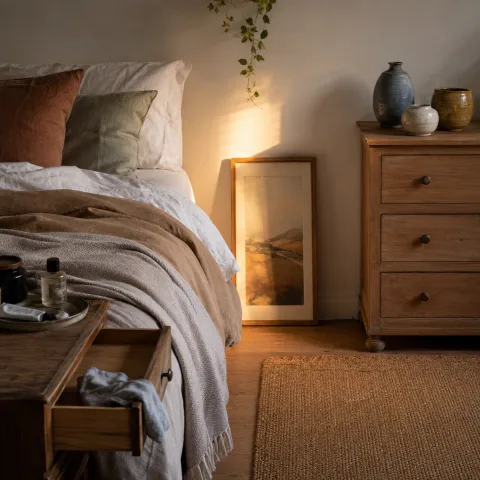
We spent two years looking at the wall above our bed and thinking it needed something. We tried a poster, a wreath, a small shelf with three books on it. None of it stuck. Then we walked past the Cruz Vermelha charity shop on a Wednesday and saw a battered gilt frame leaning against a tea trolley for five euros. A photograph of a Lisbon stairwell, A3 size, slipped behind the glass that evening. The bedroom has not needed anything else since.
Why one big frame beats a gallery wall
Gallery walls are a fashion that comes back every six years. They look thoughtful in magazines and chaotic in life. A single large frame, centred above the bed, lets the bed be the bed and the wall be the wall. There is no negotiation between four small images, no off-axis third frame ruining the geometry. The room reads quiet because there is one thing on the wall to read.
 Save
Save
There is also a budget argument. Five small frames at twenty euros each is a hundred euros. One imperfect old frame is five. The walls of museums are not crowded; the walls of cluttered apartments are. Which space do you want your bedroom to feel like.
Why the imperfection matters
A pristine new frame fights the room. A scuffed old one settles in. The brass corner that has gone a little green, the glass with two faint scratches near the top, the velvet backing that has worn through in one square inch — these are why the frame works. Hand-carved imperfection on a flat plaster wall is the only difference between hotel and home.
 Save
Save
“Hand-carved imperfection on a flat plaster wall is the only difference between hotel and home.” — Mira
- Look for frames with original glass — slight waves are a feature, not a defect.
- Avoid spray-paint touch-ups. The original gilt has depth; the touch-ups read as plastic.
- Check the back. A cardboard backing means a print frame; wooden backing means a frame that held something cared-for.
- Test the hanging hardware before you buy. Old D-rings are usually fine; old wires are usually not.
How to do it
Centre to the bed, not the wall.
The wall is wider than the bed; centring on the wall throws the frame off the bed's axis. Pencil-mark the centre of the headboard, drop a line, hang from there.

Hang at face height when seated on the bed.
Standing eye-line is too high. Sitting on the edge of the mattress, looking forward, is where the frame should land. Around 140 cm from the floor, in our case.
Use one nail, not two.
A single picture hook lets the frame settle slightly off true level, which old frames want to do. Two nails fight that, and the frame ends up looking forced.
Frequently asked
What if I cannot find a print I love?
Can I do this in a rental?
Should the print be inside the frame, or float behind glass?
In closing
The bedroom did not need a redesign. It needed one good frame, in the right place, doing the only job a frame should ever do — making the room around it stop trying. We have walked past dozens of charity shops since, and bought no other frames. There is no point. The wall has the one it needs.