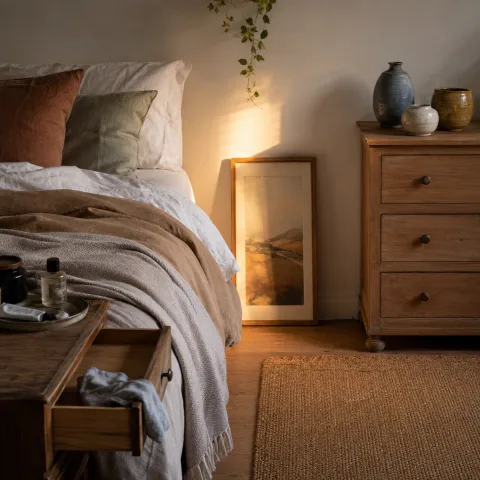
The frame had been waiting behind a stack of unfinished projects: an amber wooden border, a glass panel with a hairline chip, and a slip of cardboard where a photograph used to be. I wiped the glass with a tea towel, found a pressed leaf in a book, and cut a mat from an off-white sheet bought at a market stall for three euros. Hanging the print above the dresser took ten minutes — measure, mark, screw in a small hook, and level the frame. It sounds trivial, but that small object now anchors the room. The print is modest — a single spray of eucalyptus rendered in ink — and yet it’s become the first thing we look at when we wake. That morning ritual, unplanned and steady, is what I want to write about: how a tiny, inexpensive choice and careful placement can shift the tone of a bedroom.
The object that started the habit
On a morning that felt ordinary, the frame became an outward marker of a private routine. I reached for my glasses on the dresser, paused, and noticed the print. The eucalyptus sketch is the kind of study you expect to find in an old naturalist book: a stem, a row of paired leaves, a tiny notation in faded ink that I now pretend is the artist’s signature. There is nothing dramatic about it; its scale is close, the paper shows the faint tooth of age, and the mat’s three-euro edge gives the whole object a modest silence. The first mornings we saw it because we happened to look; after a week we looked because it was there. Small domestic rituals, like making coffee or folding a shirt, settle more easily around objects that are quietly present.
There is a particular satisfaction in repurposing. The frame was free — something inherited from a friend clearing out a studio — and the matting taught me to accept inexpensive finishes. The three euros paid for a single sheet of thin cream card; the cut isn’t perfect when you look closely, but from a normal standing distance the ragged edge reads as handmade rather than neglect. That unevenness matters. It signals a decision, an attachment. We could have bought a mass-produced print, but the fact that this one has a small imperfection means we notice it differently. It resists the slick anonymity of objects designed to vanish into a trend.
Why a framed study feels like company
A small framed study isn’t meant to dominate; it keeps a human scale. Bedrooms benefit from objects that read as companions rather than trophies. The eucalyptus drawing seems rooted in the act of looking: it invites a slow focus, like reading a line of type again to be certain of the sentence. When one shares a small space — our bedroom is modest, with just enough room for the bed and a low dresser — such attentiveness to scale prevents the visual equivalent of shouting. This is part craft and part courtesy: choosing an object that asks you to bend closer rather than recoil keeps the room calm.
How a tiny object rearranged our mornings
The change was not immediate, and it wasn’t dramatic; it was a new punctuation mark in our first moments. Rather than reaching into the dark for a phone, the eyes find the printed leaves. The habit shifted the tone of waking — a small delay that often lets a thought finish before the day begins. We noticed this not as a design triumph but as an accumulation of tiny, sensible choices: a frame, a mat, a hook at eye-level. Each decision was inexpensive, but together they became infrastructural to our mornings.
Why eye-level matters more than centering
When we first moved into the flat I made the predictable mistake of treating every wall as a vertical plane to be centered. The framed print sat for a few days, too high above the dresser, politely observing us from a distance. It was passable, but it did not feel intentional. Lowering the hook by roughly ten centimeters — enough to meet a standing eye at the shoulder — changed the conversation. Eye-level placement is not about symmetry; it’s about aligning with the body’s habitual line of sight. That small adjustment turned the frame from decoration into a point of contact.
There are rules floating around about hanging art at 57 inches (145 cm) from the floor; these are useful but not absolute. In a small bedroom with low ceilings and a short dresser, the reference point should be the human who uses the space. For us, that meant testing. I marked a line with painter’s tape and stood back, then sat on the bed and adjusted. Eye-level can shift depending on posture and function: a piece above a reading armchair sits lower than one above a console meant to be noticed from across a room. In compact spaces the test of sightline matters more than arbitrary numbers.
Measuring for real life, not a template
The most useful measurements are the ones you test with your body. We measured the dresser height, then simulated standing and reaching as though we were getting ready in the morning. I recorded the height where my eyes naturally fell and dropped a mark. If you have two people sharing the space, meet somewhere in the middle of your habitual lines; compromise matters less than finding a single place you both can look to without stooping. This small empathy prevents frames from becoming awkward when someone else walks into the room.
Why vertical spacing above furniture needs restraint
There is a temptation to give an artwork breathing room by leaving large areas of empty wall above furniture; in big rooms that can be elegant. In a small bedroom, however, too much space feels decadent in the wrong way — a picture floating in a wall of nothing. Pull the frame closer to the top edge of the furniture so it reads with the dresser, not above it. That visual friction makes the two objects belong to the same sentence rather than separate paragraphs.
 Save
Save
How we found the frame and the three-euro mat
The frame was a fluke: a friend clearing out a studio left a cardboard box of frames by a gate. I rescued an amber-wood frame because it felt honest — no brass flourish, no fake distressing, just warm wood and a small chip on one corner. The mat came from a market stall where a woman sold off-cuts of card for framing and craft projects. Three euros bought a sheet long enough for two mats. I took a utility knife and a metal ruler to the cardboard on the kitchen table, not because I expected a perfect result but because I wanted the work to feel owned. Imperfect edges read as tender when the rest of the room is restrained.
When you’re on a small budget, the process matters more than the price. Choosing to mount a small botanical study ourselves taught us to notice scale and negative space in ways a store-bought print would not have. It also produced a new repertoire of small skills: how to cut a mat with a craft knife without tearing the edge, how to clean glass without leaving streaks, and how to centre a print without using clamps. These skills are marginally useful and, more importantly, pleasurable in the way of small domestic crafts — slow tasks that make an object feel like an achievement rather than a purchase.
Tools, costs, and the value of cheap mistakes
Our total cash outlay was under ten euros: three for the mat, zero for the frame, a couple of euros for a packet of small picture hooks we already had, and the time I borrowed from a neighbor’s drill when a small pilot hole was necessary. That small budget helped us accept the inevitable small errors. The mat’s corner is a touch uneven; the frame’s inner glass has a faint chip you only notice from a very particular angle. These are not weaknesses but stories. Cheap mistakes teach faster than expensive ones because the cost of trying again is low.
Small repairs that preserve rental deposits
Because we live in a rental, we were careful about the hardware. We used a small picture hook and avoided large anchors that would require repair. For anything more substantial, a removable adhesive hook would be a better option, though its weight limit is lower. When in doubt, opt for the method that leaves the smallest mark. If you do need to fill a hole later, a tiny dab of spackling and a coat of touch-up paint is all it takes — far cheaper than replacing the whole wall surface. Small choices have long tails where deposits are concerned.
Measuring and marking without fancy tools
We didn’t own a laser level or a stud finder. Instead we used a tape measure, a pencil, and an old spirit level that lives in the kitchen drawer. I measured the height of the dresser, stood back and marked the point that aligned with our eye-line when both of us were standing. Then we measured the hanging hardware on the frame — the distance from the top edge to the hanging point — and translated that to the wall. These simple arithmetic steps are unromantic but reliable. They replace guesswork with a small practice of attention.
Marking with painter’s tape is a tiny ritual that reduces error. Place a short strip on the wall where you want the hook to go, then mark the point on the tape. If you need to shift the position, peel the tape and move it; the wall shows no residue and the tape gives you a precise visual. When drilling a pilot hole, a small piece of tape over the point keeps the drill bit from slipping. These small protective actions are the difference between a dozen minor errors and a single clean result.
How to test height with a piece of paper
If you don’t want to mark the wall, tape a strip of paper at the approximate height and hang the frame from it with a clothespin or temporary hook. Step back and live with that arrangement for a day or two. We did this while deciding whether to center the print over the dresser or slightly to the left to balance a lamp. Time and a taped paper stand-in are inexpensive ways to avoid committing too early.
Gentle leveling and the eye’s tolerance
Perfectionism is the enemy of domestic contentment when it comes to small frames. A hair off-level is invisible after a week. Use a small spirit level to make sure the frame is not dramatically askew, but don’t obsess over the last millimeter. The eye is tolerant; the mind appreciates intent. The care you take in choosing placement matters more than the micro-adjustment.
 Save
Save
Choosing the hook, fastener, and small hardware
We used a small picture hook rated for the frame’s weight. In Portugal’s thick-plaster walls, a small screw with a rawlplug is often the right choice; in drywall, a self-adhesive picture hanger or a hollow-wall anchor sometimes works better. Know the weight of your frame and choose accordingly. If you graft meaning onto the object as we did, you don’t want it to fall because of a cheap hook. The right hardware is a small insurance policy against repair and regret.
There is a place for removable solutions: if you move frequently or are limited by a strict landlord, command-strip style hangers or adhesive hooks rated for picture hanging can be a sensible compromise. Test them on a hidden area of the wall first; some adhesives lift paint when removed. When possible, use the smallest permanent fix you need. Tiny holes are easily patched later with a dab of spackle and a light sanding — far less fuss than replacing an entire section of wall.
Drilling a pilot hole without drama
If a pilot hole is required, choose a drill bit slightly smaller than the plug, hold the drill steady, and stop as soon as you feel the plaster give way. We borrowed a small cordless drill and used a piece of masking tape on the bit as a depth marker. The pilot hole keeps the plug from cracking the plaster and gives the screw something solid to bite into. Slow, steady pressure and patience beat speed in these small jobs.
Finishing touches that matter
Once the frame was up, we wiped the glass, aligned the mat so the print sat centrally, and rearranged the dresser surface to balance the composition. A lamp on one side and a small ceramic dish on the other became punctuation marks rather than clutter. The small arrangements around an artwork matter as much as the work itself; they help the eye land and rest, which is the whole point of placing a single framed study above a low piece of furniture.
 Save
Save
The dresser as a stage: styling modestly
We treated the dresser like a small stage rather than a storage catchall. A single lamp, a ceramic tray for everyday items, and a folded linen throw occupy the surface. The framed print is the quiet lead; the objects on the dresser are supporting actors. When styling, less is more: remove the things that are only there because they fit the surface. The negative space around objects matters as much as the objects themselves. This restraint keeps the eye focused and prevents the framing choice from feeling like a concession made to clutter.
We changed the arrangement twice in the first month. The first composition felt too symmetrical; the lamp directly under the center made the whole tableau feel staged. Shifting the lamp slightly left and placing the books and ceramic dish to the right created a small visual triangle that made the framed print read as the vertex of a composition rather than its center. These are small moves but they matter: a well-balanced dresser gives the framed piece context and makes the whole corner feel intentional.
Everyday items as props
Objects that are useful every day — a dish for jewelry, a stack of well-thumbed novels, a jar with a brush — make the staging feel lived-in rather than contrived. We let the everyday stuff stay visible if it looked orderly; a ceramic tray turned the keys and pocket change into a deliberate pile rather than an accident. The presence of useful objects around the framed print emphasizes that the work is integrated into life, not a museum piece removed from daily habits.
Light, shadow, and micro-moments
The way light passes over the dresser in the morning and evening contributes to why we notice the print. A single west-facing window casts a long, slanted light in late afternoons; in the morning the room is softer. We leaned into those micro-moments by choosing materials that respond to light: matte paper, warm wood, and unglazed ceramics. These textures catch shadow gently and give the small composition a changing quality that keeps it interesting without being dramatic.
 Save
Save
Why small art can outlast the big purchase
Large, trendy pieces often promise an immediate lift but can age quickly when the trend passes or when the rental changes. Small art that fits the body and the room’s rhythm is more adaptable. The botanical print we hung has a quietness that allows it to travel from apartment to apartment, to work with different paint colors and furniture arrangements. Its modest scale makes it forgiving and easy to recompose, and because its presence is about attention rather than imprinting style, it integrates more readily into new contexts.
Buying less and choosing deliberately also reduces regret. We once spent an afternoon chasing a large canvas because it seemed like an obvious upgrade, but it never felt settled. A small print, pocket-sized and made to be noticed up close, asks for interaction. That interaction — a glance, a recollection of the person we bought it from, or the market stall where the mat was cut — accumulates into a story. The story is the object’s long-term value.
Moving, packing, and the portability advantage
Portability matters when you move frequently or live in small rentals. A small frame slips into a box and doesn’t require special handling. Because the piece is inexpensive, you feel freer to arrange and rearrange it. That lightness of ownership creates a different relationship with objects: they are companions rather than commitments. This is especially valuable in urban life, where the next place may have a different light, a different wall texture, and different possibilities for the same small object.
When a small piece carries memory
The sentimental value of small things is often underestimated. A tiny print can become a mnemonic device — the smell of the market, the feel of the mat’s edge, the friend who gave the frame. These associations are not flashy, but they build the kind of domestic depth that makes a rented place feel steady. Over time the object becomes less about decoration and more about a shared history you can point to when you say, 'We hung that the week we learned to make coffee on the camping stove.'
“Small objects make the room habitually kind; large ones only occasionally brave.” — Mira Aslani
A short how-to: hang a small framed print above a dresser
Below are the practical, tried steps we used. They assume a basic set of household tools and a modest frame. The procedure is intentionally spare because the point is to make a careful choice quickly and with minimal fuss. If you prefer to experiment, try the paper method described earlier before making holes. The following steps mirror what we actually did, with small annotations about hardware choices and finish work.
- Measure the dresser height and stand where you normally get dressed to find a natural eye-line.
- Measure the distance from the frame’s top edge to its hanging point and subtract that from your eye-line mark to find the hook spot.
- Place painter’s tape over the spot, mark the pivot point, and, if needed, test with a taped paper substitute to live with the placement for a day.
- Install a small picture hook or screw with a plug appropriate to your wall, hang the frame, level gently, then style the dresser surface to balance the composition.
What we learned after six weeks
The most surprising lesson was how a small, inexpensive object can reorient attention. We did not expect the print to become a daily ritual, and yet it has. The modest investment produced disproportionate returns: mornings that begin with a small look, a pause that escapes the immediacy of our phones. This habit is not revolutionary; it is simply a change in habit that made the bedroom feel a little more deliberate. The material economy of the project — low cost, low labor — is what makes it accessible and repeatable.
We also learned to be less precious. The mat’s slight unevenness, the frame’s chip, the tiny nail hole all contributed to a feeling of ownership that a pristine new purchase would not have delivered. Things that are earned through small domestic labor provoke different attachments than things bought pre-packaged. There is pleasure in the small skill set you acquire through this kind of work, and that pleasure is part of the object’s value.
How the change spread to other corners
Once the dresser felt considered, we noticed other untidy corners that needed a small intervention: a bowl for mail, a hook for keys, a trimmed plant on the windowsill. The change wasn’t about style but about the steady, accumulative force of small decisions. It’s easier to maintain a room when the first thing you see each morning is calm and modest, because calm begets calm. This is the logic of low-effort rituals: one quiet thing supports many others.
When to stop rearranging
There is a temptation to keep searching for a better balance. After six weeks we stopped fiddling and let the arrangement become part of the room’s habit. If a spot of light changes or a new object arrives you'll adjust again; that’s the pleasure of living with things. But initial restraint and a willingness to leave the arrangement alone for a while give an honest test: if the object still matters after a month, it has earned its place.
How to do it
Find the eye-line
Stand where you normally dress and note where your eyes naturally rest; record that height as the frame’s visual center.
Measure the hanging point
Measure from the top edge of the frame to the hanging hardware, subtract that from your eye-line mark, and transfer that point to painter’s tape on the wall.
Install the appropriate hardware
Choose a small picture hook or screw with a plug suitable for your wall type, drill a pilot hole if required, and fit the hardware carefully.
Hang, level, and style
Hang the frame, check the level gently with a spirit level, then arrange a lamp and a small tray on the dresser to balance the composition.
Frequently asked
How high should a small print be hung above a dresser?
Will small hooks damage plaster walls?
Can cheap matting look good?
What if two people have different eye-lines?
In closing
If there is one rule I would offer after six weeks of living with this little picture, it is this: place the thing you intend to see at eye-level, and accept that not every object must shout. The framed print above our dresser didn’t alter the floor plan or require a new sofa; it offered a single steady point, an introduction to each day. When decisions are small and deliberate they invite attention rather than distraction. In a rental, with a limited budget and a short to-do list, that kind of return on ten minutes of careful work is quietly remarkable. Leave room for other small things to be seen, and let one modest object do the heavy lifting of making the room feel like yours.