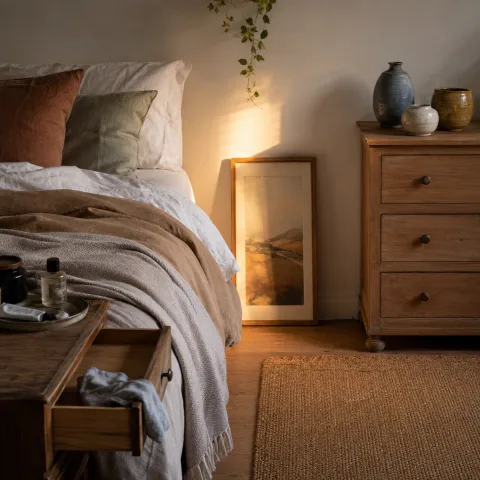
At night the bedside table read like a category page for small things: loose change in one corner, a dull stud in another, the hair tie that had been there for weeks, and a pen—always the pen—rolled against yesterday’s bookmark. The surface itself was small, the kind that makes every object feel like an argument. One Saturday morning I brought home a shallow brass tray and a tiny ceramic bowl, because the apartment needed fewer scatterings and more places that told a story rather than paused mid-accident. The tray is wide enough for a ring, a watch, a folded note; the bowl holds the things that slip and hide. The swap was modest, almost ceremonious: four objects into two vessels, and the bedside, at once, looked as if someone had paused to tidy rather than to tidy up. That pause grew into a ritual.
The small clutter that signals a larger habit
Before the tray arrived, the bedside surface functioned as a spillway. Things arrived there because the bed was near the door and because pockets, purses, and life shed small items in a lazy cascade. The objects had in common that they were too small to notice at a glance: a single stud earring with a dull back, a loose button, a coin that had once been useful, the edge of a receipt. Each thing felt important at the moment it was set down, and then instantly anonymous. The result was visual noise; the table read as distracted, a short essay on postponed decisions rather than a restful edge to the bed.
There is a peculiar economy to small clutter: a coin is a coin, but its presence in the bedroom signals a different story than a coin in a wallet. That difference struck me after a week of noticing where my hands landed. The loose things were not random; they were bookmarks for incomplete acts — a hair tie left to be used later, a pen abandoned mid-jot, a ring removed for sleep. Each object was a stub of an intention rather than the thing itself. Looking at the pile felt nagging, like a chorus of unfinished sentences at the edge of rest.
That’s the soft argument for containment: when small things are placed deliberately in a vessel, they stop speaking for themselves and start to enter a pattern. A single shallow tray or a bowl makes a tidy out of chaos, not by banishing objects, but by giving them an address. The table becomes a stage with two mailboxes. The change feels minor to explain — it’s literally just a tray and a bowl — but habit respects boundaries, and boundaries, once visible, are easy to follow.
Why containment works
Containment reduces decision friction. When an object arrives at the bedside you no longer have to decide whether to tuck it into a drawer, put it on the shelf or simply leave it. The existence of a designated place yields an easy answer: if it’s small and used often, drop it in the bowl; if it’s a watch or a glasses case, lay it on the tray. The trick isn’t to be puritanical about what goes where; it’s to create a small map that your hands can follow without thinking. Over time, that follow-through changes how often objects scatter in the first place.
The psychology of giving things an address
We respond to visible rules. A tray is not a rule written in capitals, but it acts like one: it says, ‘this is where these live.’ That terse instruction reduces the small daily friction of tidying. In our house the rule is forgiving — one bowl, one tray — which matters for adherence. Hard rules are easy to break; generous rules are easy to keep. The result is less time spent rearranging and more time where it matters: reading in bed, listening to the radiator, or simply noticing the lamp’s halo as the evening settles.
Choosing a tray and a bowl that invite use
We chose brass and ceramic for reasons that were partly practical and partly sentimental. Brass is forgiving; it accepts fingerprints and will develop a soft patina that makes it look like it belongs. A shallow tray — not a deep bowl masquerading as a platter — keeps watches and glasses visible so they aren’t forgotten. The ceramic bowl, compact and matte, seemed to understand small things: its slope catches tiny studs and buttons rather than letting them roll to the edge. Together they read like a pair, but each holds a distinct function.
Material choice matters as much for how an object is handled as for how it looks. A plastic tray feels provisional and will encourage casual dumping; metal and ceramic invite care. Weight is also important: a too-light bowl can be knocked over, while a too-heavy tray makes the small table feel top-heavy. We deliberately sought pieces that felt tactile in hand — brass with a gentle warmth, ceramic with a chalky rim — because objects that encourage touch get used in the right way. The right objects ask to be handled, which is the point.
Size is the practical conversation that follows material: the tray should be broad enough for daily wear items but not so large that it swallows the bedside’s personality. Our tray measures roughly 22 by 14 centimetres — shallow and wide — which allows a watch and a pair of glasses to sit with a small folded note or a receipt without crowding. The bowl is smaller, about 8 centimetres across, and deep enough to catch things but not so deep the contents vanish. Those dimensions suit the table they live on: a narrow wooden top with an old varnish and a edge marked by years of cups.
Budget and the secondhand question
We did not buy new. A shallow brass tray from a Lisbon flea stall had a few dents and a warmth that new shiny metal lacks, and the ceramic bowl came from a potter who sold mismatched seconds for a reasonable price. Secondhand objects often come with the right kind of wear — the smudge of previous hands, the softened edge — that makes them easier to live with. If budget is tight, look for well-made seconds or small vintage finds; a tray needn’t be designer to be dignified.
What to avoid
Avoid organizers with too many compartments or labels. They turn the bedside into a small bureaucracy and require maintenance you don’t want at 11:30 p.m. Also avoid slippery finishes that make things slide off in the night; texture matters. A tray with a subtly raised lip is helpful, as is a bowl whose glaze isn’t so glossy that a ring slips like a marbled shape. These are small choices but they change how the objects behave when handled in low light and half-attention.
 Save
Save
Placing the vessels: not too close, not theatrical
Where you put the tray and bowl matters almost as much as what you put in them. We considered the obvious choices — center stage, flush to the wall, directly under the lamp — and rejected them because those positions either made the table look staged or created awkward reaches in the dark. The sweet spot for us was slightly off-center, toward the edge where the bed meets the table. It’s close enough to reach without turning, but not so close that items might be swept off in an earnest bedtime elbow.
We also left some empty space. An arrangement that crowds the entire surface is less likely to become a habit and more likely to feel chore-like. A small ritual needs breathing room: an easy path for your hand, a visible bowl lip to drop something into, a tray edge to set a watch upon. The visual pause is as useful as the vessel itself; the table has to say, gently, that this is a place for stopping.
Finally, consider the lamp and other vertical elements. A lamp that crowds the tray will cast harsh shadows across the bowl and make it hard to retrieve tiny items. We nudged our lamp back a few centimetres and replaced a heavy shade with a slimmer linen one; the light softened and the tray read more clearly. Small changes like that cost nothing but a little attention, and they pay in fewer late-night fumbles and fewer overlooked earring backs.
Symmetry versus usefulness
It’s tempting to align the pair symmetrically, but symmetry can feel like staging. We favoured a deliberate imbalance — the tray toward the bedside edge, the bowl closer to the lamp — because that arrangement follows how hands actually move. Usefulness wins over perfect lines in small spaces; a dish that’s easier to reach will be used more often than a dish that simply looks tidy.
Consider adjacency: the book, the glass, the alarm
Place the tray so it doesn’t compete with the bedtime essentials. Our tray sits beside the book, not under the glass of water; the bowl sits between the lamp and the wall, out of direct spill paths. These are small, almost obvious choices, but they prevent accidental knock-overs and make the nightly tidy feel effortless. Once the objects stop being obstacles, they become part of the ritual instead of the chore.
 Save
Save
The night ritual that grew from a small edit
The first few nights the tray and bowl were novelty. By the second week they were habit. The ritual is simple: when we climb into bed, one of us checks pockets and drops anything small into the bowl — a coin, a hair tie, a ring removed for sleep. The watch and glasses go on the tray. If the bedside surface is tidy, the mind can be quieter. The small act of setting things down becomes a signal that the day is closing; it’s not grand, but it matters. It punctuates the day in an intentional way and it takes less than a minute.
There is a social element to it as well. When living with someone, habits are contagious. The first night I used the bowl, Theo noticed and the following evening he followed. It wasn’t enforced; it was observed. That gentle mimicry is why small rituals stick. They are peer-reviewed in the domestic sense and, if they’re pleasant, they spread. Rituals don’t have to be loud to be meaningful; a shared smallness is enough to alter the tenor of an evening.
The ritual also reclaimed a few seconds of attention. Instead of skipping past the bedside and leaving things scattered for tomorrow, we take the moment to see what came with us during the day. The act of dropping a ring into the bowl prompts a small story: why is that ring off, where did that coin come from, is that receipt worth keeping? These brief checks are a form of micro-decision-making that reduce the pileup of indecision that used to accumulate. Over the weeks the room looked calmer and felt calmer, which is different and valuable.
When the ritual falters
Rituals are fragile. They break on travel, late nights, or when one of us is sick. On vacation we revert to pockets again, but the return is easier now; after a weekend away the tray and bowl feel novel again, and we naturally reintroduce them. When the ritual falters at home, it’s usually because we let the surface collect secondary items — receipts, a stray grocery list — that compete for space. The remedy is simple: remove the intruders and re-locate the vessels so that the ritual has its clear, unobstructed place.
The pleasure of handling
There is a small tactile pleasure in placing things in a tray or bowl that a drawer never provides. The coolness of brass, the matte resistance of ceramic, the way a ring nestles into a curve — these are tiny satisfactions that anchor a habit. They are sensory confirmations that you have completed an action. We underestimated how much that mattered until the habit was established; a ritual that feels pleasant is a ritual that lasts.
 Save
Save
Care, patina, and the argument against over-cleaning
Brass will change, and that change is a feature not a flaw. The tray will develop a patina where hands most often touch it, and that unevenness becomes part of the object’s story. We resisted the urge to polish nightly; instead we let marks sit until they bothered us, which was seldom. For cleaning, a gentle wipe with a soft cloth and occasional dish soap for the bowl is enough. If you prefer a brighter brass, a light polish once in a while will restore the shine, but bear in mind you’ll be polishing personality away.
Ceramic care is plain: avoid thermal shock and treat the glaze with respect. The matte bowl we use has a hairline crazing that only deepens its character; it’s never been a problem for daily handling. If a tiny earring falls and hides under the glaze pattern, it’s part of the fun to fish it out. Small imperfections are the material telling you it has lived. This attitude — to accept a bit of wear — changes the relationship you have with objects. They stop being museum pieces and become tools for life.
If you rent, take photos before you polish everything back to new. Some landlords expect a polished flat, but others appreciate the warmth of lived-in metal. When in doubt, a removable felt pad under the tray will prevent scratches on the table surface and is reversible for end-of-tenancy cleanups. Small protective measures keep both your objects and the table happier without erasing the little marks that make a place feel lived in.
Cleaning brass without losing the story
A gentle method: warm water, a drop of mild soap, a soft cloth. Rub where necessary, rinse, dry immediately. For stubborn oxidation, a paste of baking soda and lemon will help, applied sparingly. Test any treatment on an inconspicuous corner. The goal is not to erase history but to keep the object functioning and pleasing to touch. We find that occasional light cleaning preserves usefulness while allowing the object to age with dignity.
Repair and modest mending
If a tray develops a dent or a bowl chips, consider modest repair rather than replacement. A small ding in brass can be gently hammered from the back and will look better for having been used. Slight chips in ceramic can be stabilized with food-safe epoxy and painted over if they are visible. We prefer repair because it extends an object’s life and avoids disposal. The work is usually small and affordable, and it reinforces the idea that objects are for living with, not for preserving under glass.
 Save
Save
Four small steps to adopt the habit tonight
If you want to try this tonight, the process is brief and almost ceremonial. The idea isn’t to impose a new chore but to introduce a small structure that your hands can follow without thinking. The four steps below are the instruction manual for the habit: simple, reversible, and cheap. They are meant to be adaptable — the exact dimensions and materials are less important than the invitation to handle things differently.
- Place a shallow tray and a small bowl on your bedside table, leaving some empty space around them.
- Decide what each will hold — for example, tray for watch and glasses, bowl for loose jewelry and hair ties.
- Use them for one week without rearranging; notice how your hand reaches and adjust placement if necessary.
- If the routine sticks, make a small ritual of emptying the bowl weekly and returning anything that needs a permanent home.
Why this tiny edit matters beyond neatness
The change is psychological as much as aesthetic. A tidy bedside is not simply about looks; it changes how evenings begin. There is an ease to bedtimes that are punctuated by small intentional acts. Instead of the mind jogging at all the things tomorrow requires, the act of setting down a ring or placing a watch allows those small items to be acknowledged and set aside. Containment creates permission both to finish a day and to return to tasks later with less friction. That permission, small as it sounds, accumulates.
Moreover, the edit is democratic: it doesn’t demand a new shelf or a multipiece organizer, which often requires time, money, and fuss. One brass tray and a bowl are inexpensive and portable; they work in a tiny rented flat and would not feel out of place in a house with a mantelpiece. The minimalism here is not ascetic; it’s an invitation to make fewer decisions better. In other words, buy less but buy something you can live with and that will invite the habit you want.
Finally, habits like this protect attention. The world presses for our time and focus; small domestic habits create brief thresholds that help signal transitions. A bedside that is tidy is a small, domestic courtesy you give yourself. It costs little and returns a surprising amount of calm. If you are tempted by bigger projects, try this small one first; its benefits compound, quietly.
“Small vessels do the hard work of making small things seem intentional.” — Mira Aslani
How to do it
Choose two vessels
Select one shallow tray for daily wear items and one small bowl for loose pieces; prioritize tactile material like brass and matte ceramic.
Place them with intention
Set them on the bedside table where they are easy to reach from the bed but not under the lamp or in a spill path.
Use for one week
For seven nights, drop small items into the bowl and set watches and glasses on the tray without rearranging; observe reach and adjust placement if necessary.
Empty and review weekly
Once a week, empty the bowl and return any items that need a permanent home; wipe the tray and bowl as needed.
Frequently asked
Will the brass scratch my bedside table?
What if the bowl becomes a magnet for receipts and junk?
Can I use different materials if I don’t like brass?
Will this still work in a very small bedroom?
In closing
The rule I keep now is simple: give small things a room to be small. The brass tray and the ceramic bowl do that without being showy; they accept the mess, hold it, and make it legible. In practice the edit cost less than a dinner and took longer to get used to than it should have — habits are stubborn — but once the night ritual settled, the table began to mean something different. It became a pause, a small tidy, a little benediction before sleep. If you are tempted to buy yet another organizer, try buying a single object that invites handling first. It will teach you more about what you keep than any drawer ever will.