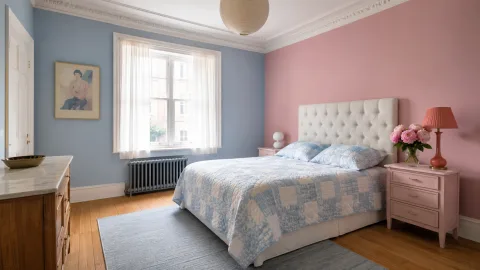
From the doorway we enter with measured steps, letting colour set the pace for the narrative that follows, rather than the pace of our own hurry. The pair of walls—blue and blush pink—are balanced by white trim that keeps the space legible, calm, and ready to receive small acts of care. The pale oak floor bears the soft imprint of daily use and echoes the room's pared-back rhythm, a reminder that beauty here grows through repetition and patience. A bed dressed in a quilt of sky blue and white anchors sight and touch, inviting a slower approach to morning rituals and evening reflections. Small, rounded furniture refuses to shout, allowing the eye to travel across surfaces without abrupt jolts, while natural materials carry warmth and patina over time. In this report we track restraint, texture, and light as they combine to create a sanctuary that supports slow living throughout the day and into the night. The room is not a perfect image; it is a working space for small daily rituals, where each fabric, each shade, and each grain of timber earns its place through use. Where one square metre might feel insufficient, the careful bounce of light and the subtle sheen on a linen headboard expands the sense of space. We observe how a single vase of peonies can alter scent, sight, and mood; how the radiator's constant heat becomes a metronome for routine; how the curtains adjust the tempo of the morning and evening hours. By lingering on these moments we uncover a method: create calm through repetition, warmth through natural materials and a palette that moves with the day. This is slow living translated into a sleeping chamber that invites stillness without surrendering function.
Soft geometry of light and fabric
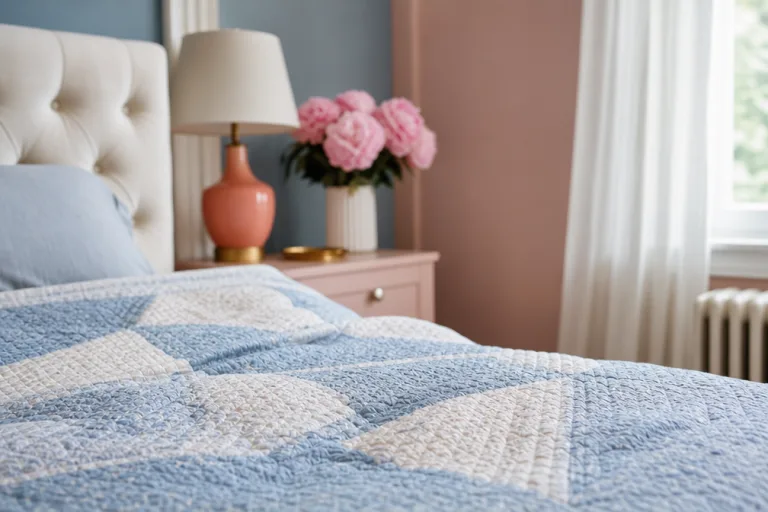
Soft geometry is the heartbeat here, with the bed as a quiet anchor and the two nightstands mirroring its silhouette across the small plane of the wall. Light enters obliquely, spilling across the quilted cover in slow, measuring waves that soften the blue and pink into a single hushed tone, as if the room wears a single atmosphere rather than discrete colours. The sheer curtains diffuse every sunbeam to a milky glow, so furniture remains legible without glare and the eye can glide from one surface to the next without interruption.
I notice the headboard, upholstered in pale linen, curved enough to invite a touch yet restrained enough to keep the atmosphere uncluttered. The quilt—two-toned blocks of blue and white—offers a tactile rhythm as you run a hand across its surface, every seam a reminder of ongoing care. The pink lamp shade casts a warm, intimate glow that rounds the edges of morning wakefulness and softens evening posture.
Furnishings are intentionally modest: the right-hand table supports a vase of pink peonies that lift the air with sweetness and a hint of daily ceremony. The radiator beneath the window grounds the room in practical reality, a reminder that comfort and function can share the same frame. Even the art on the blue wall—framed botanical sketches—keeps to a single subject and a quiet colour palette, letting the space breathe.
 Save
Save
“Calm spaces are not empty; they are curated pauses between actions.” — Mira
- Maintain one dominant colour and two supporting accents.
- Choose natural fibres to add softness and age gracefully.
- Keep surfaces uncluttered to preserve breathing room.
- Let light do the work: diffuse, not flood, the window area.
Palette and texture
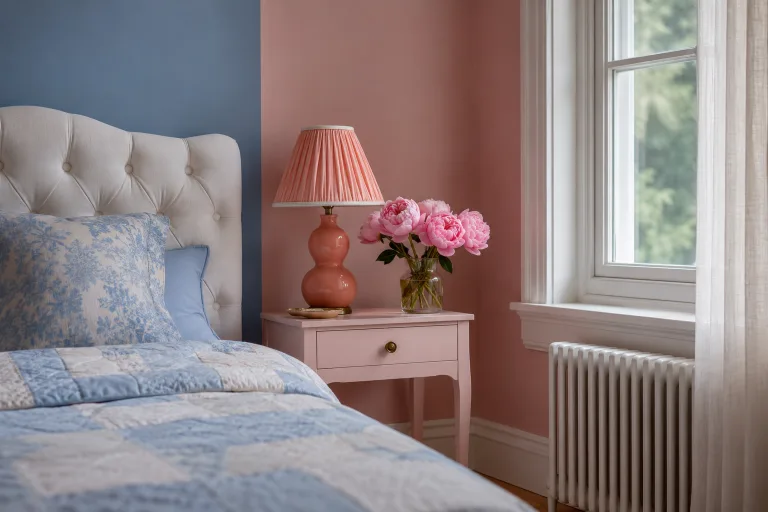
Palette and texture shift the room from a simple palette into a narrative of touch and memory, inviting the observer to slow down and notice details rather than simply absorb colour. The blue reads as sea-foam when the daylight is bright and as a softened charcoal when dusk arrives, while the pink shifts from berry-bright to pale rose under the glow of the lamp; white surfaces act as air, preventing saturation and giving every moment room to breathe.
 Save
Save
Textiles are the medium: cotton and linen ride softly at the skin, the quilted cover adds dimensionality that invites fingertips, and the linen headboard gives a quiet, maternal presence that remains unobtrusive yet present every hour.
Even the peonies contribute texture and scent; their petals catch the light differently than ceramic surfaces, and their stems add a vertical rhythm that keeps the eye moving without noise.
“Calm spaces are not empty; they are curated pauses between actions.” — Mira
Craft and placement
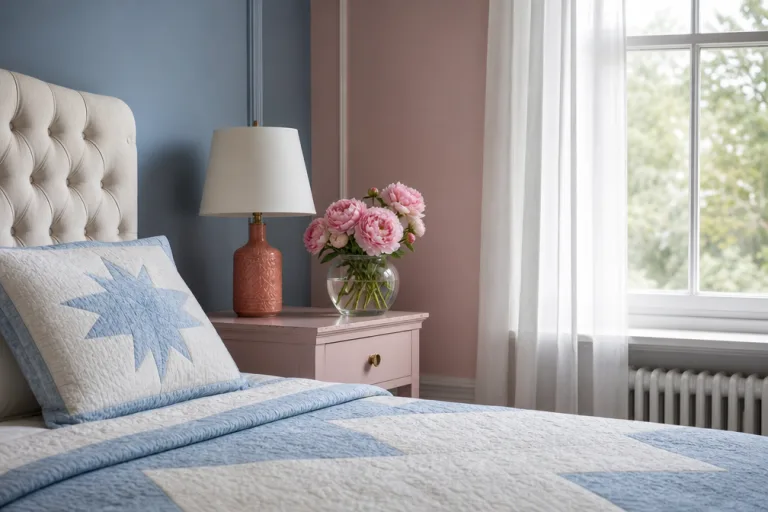
Craft and placement continue the room's restrained conversation: the two nightstands mirror each other, the lamp shades echo the pink on the walls, and the window becomes a soft focal point rather than a glare.
 Save
Save
The radiator is integrated as part of the composition, avoiding the sensation of a clumsy add-on; it anchors the seating zone and shifts with the seasons.
Each object has a reason to be there, and nothing is decorative for the sake of decoration; even the bouquet is chosen to signal daily rituals rather than fill space.
Rituals of slow living
Rituals grow from small acts: a mug warmed by lamplight, a page turned beneath the same glow, the soft rustle of cotton on waking; these small actions lend the room a slow heartbeat.
Over the course of a day, the room performs as a partner: morning light becomes a bookmark for intention; dusk's warmth signals a gentle close, and the peonies' fragrance lingers as a promise of tomorrow.
How to do it
Survey the room
Take note of the dominant colour blocks and how light travels across each surface from morning through late afternoon.
Assess textiles
Check the weight, finish, and softness of fabrics; ensure textures harmonise rather than fight for attention.
Evaluate balance
Confirm that furniture is aligned and spaced to create a calm corridor of sight from door to window.
Refine touches
Remove one decorative item and replace with a living element—flowers or a small plant—to enhance freshness.
Frequently asked
What makes this bedroom feel calm?
Which colour dominates the space?
What role do textures play?
How should one approach window treatments here?
What materials are essential in this setup?
How can this look be adapted for smaller rooms?
What is the mood this room conveys at dusk?
In closing
In reviewing this space, we recognise how restraint becomes generosity. The room offers comfort through subtle shifts in shade, careful alignment, and the tactile invitation of fabric and light. It is not merely a bedroom; it is a practice in slowing down, in letting colour breathe and textures speak softly. We leave with a sense that the simplest setups can carry the weight of a morning routine and a night of restful anticipation. The discipline of keeping things close—one dominant colour, two supporting accents, a handful of well-chosen textures—gives room for memory to settle and for everyday rituals to return with renewed attention.