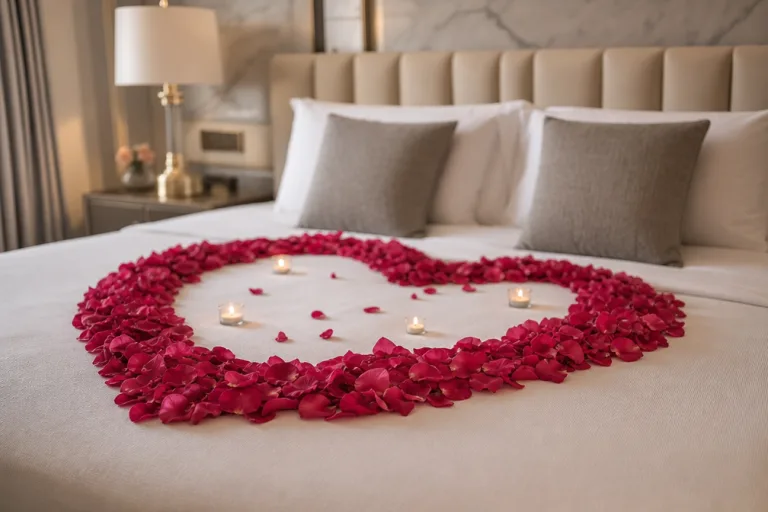
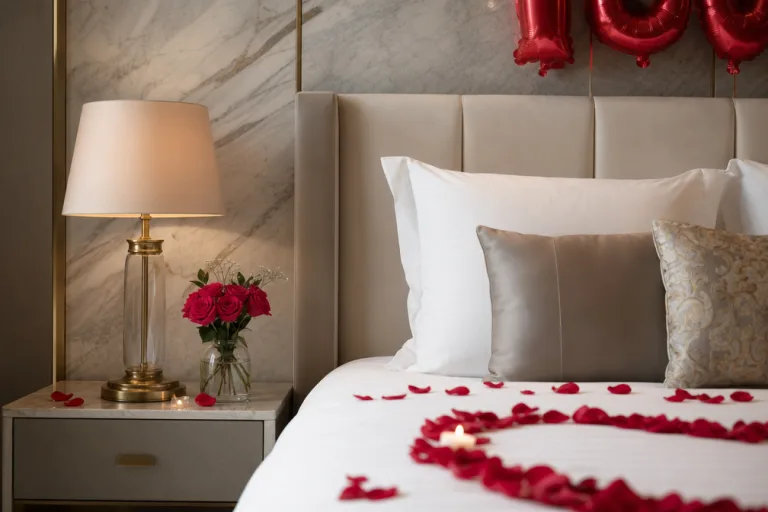
Tonight we entered the room with a quiet intention to hold time still long enough to notice the small rituals of affection, the moments when ordinary objects become carriers of care, memory, and the breath between two people. The bed, dressed in crisp white percale, acts as a pale stage for a ring of deep-pink rose petals and the warm glow of lamps on either side, while a marble-panelled wall behind the headboard catches the light and flickers with faint blue veins. We are drawn to the balance of restraint and celebration: the red foil balloons above the headboard provide a bright, joyful counterpoint, yet the scent of beeswax and the faint perfume of linen remind us that care can be slow and deliberate rather than loud. In such moments, decoration becomes a practice rather than a display, a method for listening to our own tempo and choosing tenderness over trend, so the room keeps a slow heartbeat even when the doorbell rings or the morning light breaks. The air carries a faint note of rose and linen; we sense the texture of the petals against the sheets and feel the marble’s coolness radiate through the duvet, inviting our breath to slow and join the room in a measured listening. This report records a set of careful acts—a table of choices, a sequence of pauses—that turn a private suite into a sanctuary where memory can settle, gratitude can deepen, and the simple ritual of recognising love can be returned to again and again.
Setting the scene for slow romance
We began by acknowledging the design economy of the room, choosing a restrained palette that would both support the central ritual and honour the natural variation of the materials. The white percale sheets created a clean field, while an ivory duvet added warmth without weight. The heart of rose petals was laid with a careful, mathematical calm, petals placed from the heart outward and spacing governed by a quiet measure that left space for the candles to breathe. The headboard, padded in a soft almond tone, anchors the bed against marble panels that read as a faint, cool horizon; the veining is a slow motion of grey and blue that seems to hum with memory.
 Save
Save
We measured symmetry with a level in hand and a quiet cadence in the breath, stepping back to ensure the shape was perfectly balanced. The balloons above the headboard provided a bright, celebratory counterpoint, but their glow never outshone the room’s underlying restraint. The scent of beeswax from the candles mingled with the clean scent of linen and the faint perfume of last night’s soap, a combination that invites inward listening rather than outward display. The lamps on either side—brass bases with linen shades—cast a warm halo on the bed and carved soft, raked shadows along the headboard seam. We studied the overall composition as if curating a tiny sculpture, grateful for the patience it teaches about space and pace.
“Light is not a weapon here but a partner that reveals texture and form.” — Mira
 Save
Save
- Careful symmetry matters more than bold size
- Pause to assess balance before final placement
- Keep candles with safe margins from petals
- Capture a private moment, not a public display
Texture and light in the room
 Save
Save
Texture and light travel together in this room, shaping how we feel as we move through it. The sheets’ cotton percale has a crisp edge that softens as the eye travels toward the headboard, where the fabric’s nap catches the lamp light and glows with a quiet luster. Behind, the marble wall offers a cool, mineral backdrop whose veins run like a slow heartbeat; the ash-grey traces echo the shadows cast by the petals and by the slender candles. We choose to allow light to linger rather than chase brightness, so the room’s angles become a map for slow noticing.
Every surface has tactile truth here: the smoothness of the duvet, the matte finish of the bedside tables, the slight grain of the headboard fabric, and the subtle grain of the marble that seems to absorb and release warmth as the night deepens. The petals form not merely a shape but a halo to the central bed, a living texture that grounds the air and invites touch. The balloons, though bright, reflect in the marble with a softened sheen, ensuring that colour remains part of a larger, quiet composition rather than a focal shout. The room thus teaches us to look slowly, to measure each moment and to let the light do the rest.
“Light is not a weapon here but a partner that reveals texture and form.” — Mira
How to do it
Set the palette and space
Begin with white percale sheets, a pale-cream duvet, and a neutral headboard; ensure the wall behind is clean, unmarked, and free of dust to reflect light evenly.
Arrange the petals with intention
Create a heart shape from the petals outward, maintaining symmetry and leaving space for candles.
Light and position candles
Set candles on a heatproof dish, away from petals; switch on lamps to create a soft glow.
Pause and document
Sit with the room for a moment, then photograph from the doorway before tidying.
Frequently asked
What is the significance of rose petals in interiors?
How should I manage safety with candles around petals?
How long should a rose-petal focal be kept?
Which fabrics work best with this look?
What maintenance does the room require after use?
How can this space adapt for daily living?
Is this style appropriate for small spaces?
In closing
This room teaches a patient, repeatable romance: small rituals that compound into meaningful atmosphere. The heart shape made of petals travels through time, marking moments that would otherwise drift away. We learn how light, texture and a restrained palette can make ordinary space feel intentional. The practice invites care, reflection and a slower pace, reminding us that beauty is not a destination but a habit we nurture daily. We leave with a sense that love is built in small, repeated acts. On returning to the city, we carry the room’s discipline with us—an awareness that even a few petals, a soft lamp, and a quiet wall can recalibrate a day that felt hurried. The memory of the heart’s edge, warmed by candlelight and the linen’s cool touch, returns whenever we face a decision to rush or gloss over a moment. The slow-living practice teaches us that ritual is not performance but a pedagogy of care: it teaches us to invest attention in what matters, repeatedly and gently. In that way, the room becomes more than a suite; it becomes a method for living well, one evening at a time.