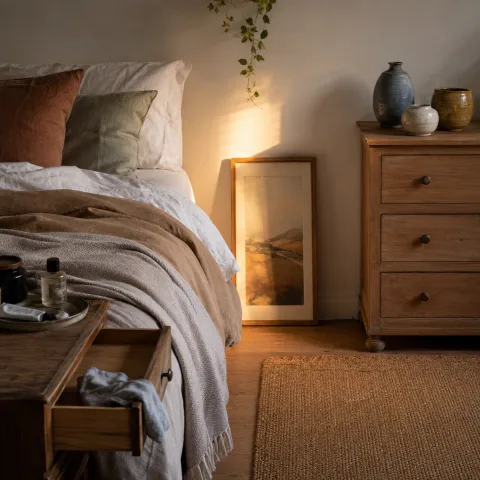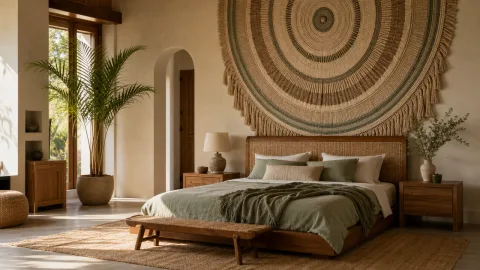
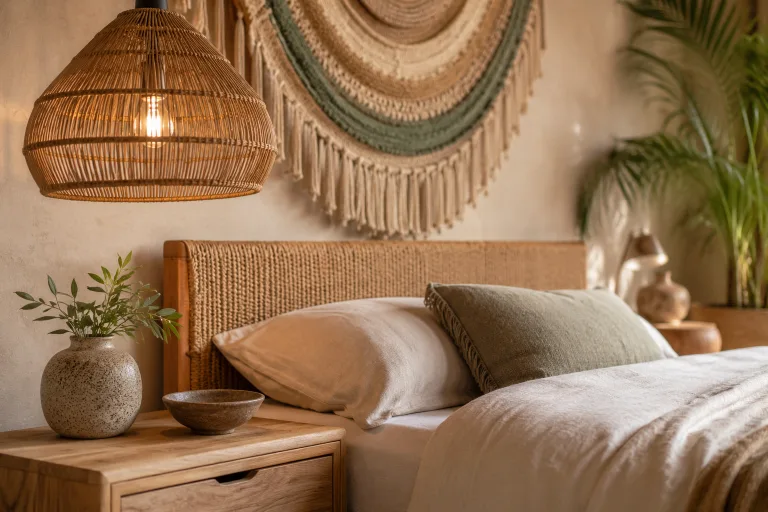
From our field notebook we arrived to document a bedroom where time slows and hands pause, a space we believed could teach us to breathe between tasks. We observe how the room's natural materials speak of patience, craft, and intention; they do not shout, they invite you to lean in and feel. We note the warm white plaster walls, the ash timber of the bedframe, and the linen, cotton and jute that soften the floor and skin alike. The bed sits low and broad, its headboard woven from pale fibres, anchoring the space and drawing the eye toward the monumental tapestry that dominates the wall. We register a deliberately chosen palette of ivory, sand, oat and sage, so the room breathes with light rather than competes with it. Even the plant in the corner holds a quiet purpose, its leaves catching the sun's glint and returning a small glow to the room, reminding us that life itself can be a design detail.
Natural textures as the spine of a calm bedroom
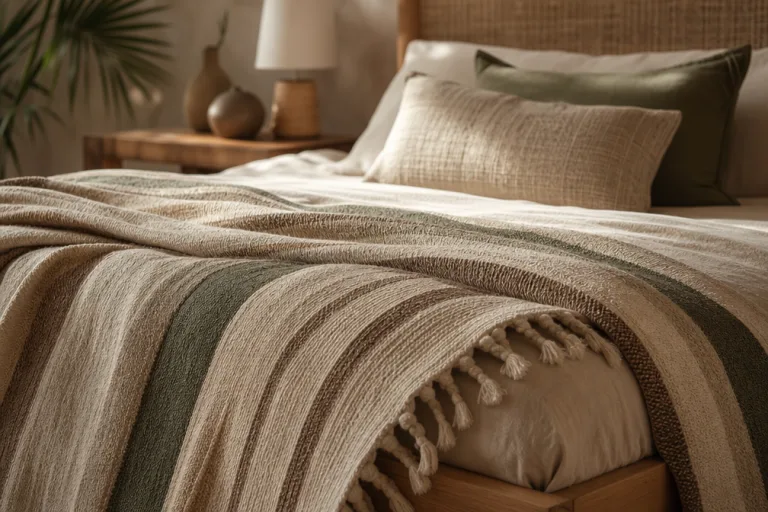
Natural textures form the spine of this room. The bed, as a low timber platform, is finished in pale ash with visible grain that wears no lacquer, letting the character of the wood breathe. The duvet is crisp linen in ivory, pressed at the edges and turned back to reveal a whisper of cream, while a throw in sand, blush and pale blue drapes over the foot like a soft shoreline. Cushions—one geometric in warm earth tones, another plain but snug—support the back and invite a restful sigh. The headboard is woven in a fibrous lattice that remains flat against the wall, so the room reads serene rather than showy. On the floor, two rugs—one thick, one flat-washed—layer underfoot, their fibres made from jute and sisal that smell of earth after rain. The palette does not rely on colour to create mood; it relies on the texture of these fibres, the hand of the weave, the tiny irregularities that remind us of human touch.
 Save
Save
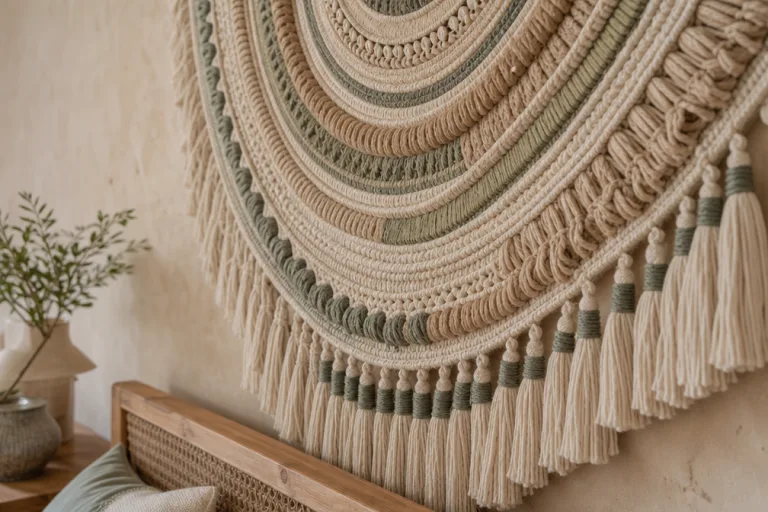
Above the bed, the circular tapestry radiates from the headboard like a sunrise rendered in threads. Rings of cord create concentric motion, and tassels hang at regular intervals in sage, oat, terracotta and dusty pink, each stripe catching the light as it moves with your breath. The central medallion holds a quiet weight, as if the room has learned a small ritual from a distant coast. This piece does not overwhelm; it orients the eye and steadies the room's tempo. The small details—the knots that form the border, the way tassels scrape softly against the wall when you brush past—are the room's language. We see the tapestry as both sculpture and map, pointing toward a slower way of being in the morning, the way you inhale the smell of linen and coffee and begin again.
Positioning light and space for slow mornings
 Save
Save
Slow mornings begin with light that travels through the room rather than floods it. A sheer curtain diffuses the sun into a soft, milky glow that plants a calm across plastered walls. The wall colour is warm white, a shade that reads differently with the hour: chalk at dawn, honey by late afternoon. The bed and its textiles catch this light, the linen turning to a creamy ivory and the throw taking on a warmer wink of peach. The bedside lamp offers a controlled radiance, a small halo rather than a blaze, so you can read a paragraph or two without glare. The window frame is a pale oak that echoes the timber of the bed, creating a quiet rhythm. We notice how the air moves with the curtains and what that movement reveals about the room's temperature and comfort.
With the light comes rhythm; with rhythm comes intention. We adjust the curtains to soften the morning without muffling the day ahead. The lamp is kept dim and warm, enough to scan a page, jot a line in a notebook, or simply sit with a cup of tea. The space seems to impose no hurry, yet it invites clarity—linen, wood and fibre aligning like a well-tuned instrument. The fragrance of the room is subtle: perhaps a vanilla candle or a tincture of dried rosemary from the kitchen, lightly carried by the air and dispersing slowly. In these moments the room becomes a coastline you can walk along, slow and sure, never rushing toward the next task.
“Texture guides the eye before colour; we tell ourselves a mantra for slow rooms.” — Mira
 Save
Save