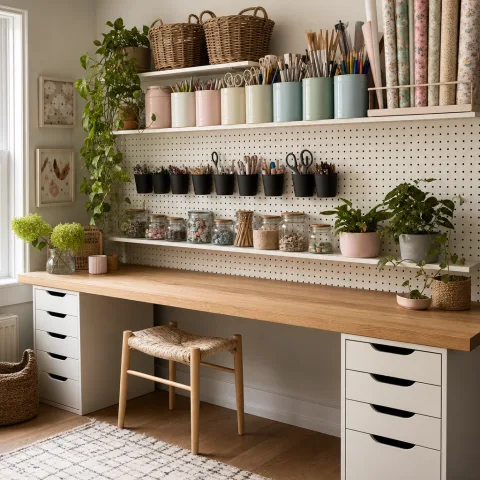
On arrival the craft corner sits at the window line, catching morning light that shifts with the day. The furniture remains practical, but the palette has been orchestrated to invite curiosity rather than competition. We watch a pair of hands test a yarn swatch, pausing to notice how the colour settles next to a thread spool. A bench, a tray and a jar of brushes form a quiet triangle that suggests boundaries and freedom at once. The air carries a faint scent of gum arabic and wax, grounding the room in craft's ordinary rituals. We note how the sight of wool, ink and fabric invites slow decision-making instead of impulsive purchases. This is not a showroom; it's a test-lab for calm making.
Gentle palette for calm crafting
In this corner the palette is modest but intentional, chosen after several weeks of gentle experiments with fabrics and dye cards. The primary colours are soft apricot, eggshell, sage and a quiet rose that reads as a whisper rather than a shout, a set that returns to itself again and again. We see how the hues are repeated across fabric swatches, thread spools and paint labels, creating a cohesive field that never feels monotonous because the textures vary. The idea is to reduce visual noise while preserving curiosity, so the bench remains legible and the maker can locate essential tools at a glance.
Small assertions of colour mark different tasks without shouting, arriving as quiet markers rather than loud signals. A zip of yellow markers here, a strip of dusty pink there, a strand of teal by the jar of brushes, these accents stitch the routine together. The rhythm comes from repetition rather than novelty, allowing mistakes to be reset by uniform tones that act like a soft metronome. Surfaces have a restraint that makes the space feel larger, calmer and more controllable because colour never competes with itself.
Texture enriches the palette with tactility and invites tactile inquiry before any colour is applied. A wool swatch, a linen scrap and a painted wood tile gather at the edge of the bench like a mini still life, suggesting how materials speak to one another. The contrast of soft and firm textures prompts gentle hands to explore without rushing, encouraging pauses that allow colour to settle and seam lines to align. A single, clear signal helps keep tools in view and away from spill-prone corners, reinforcing discipline without deprivation. The arrangement invites a pause between steps, ensuring the craft corner breathes in time with the maker.
Station layout as a still-life
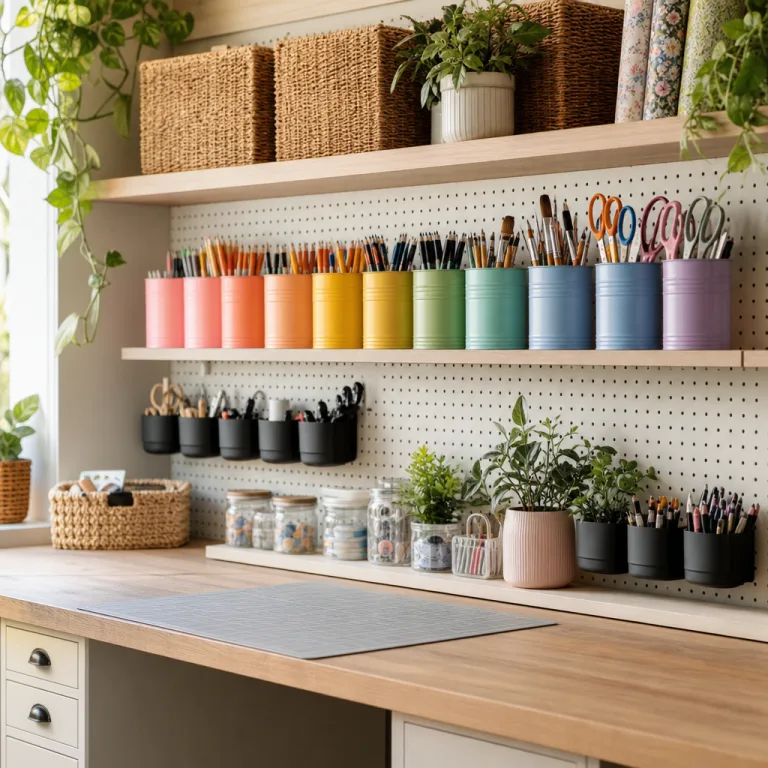
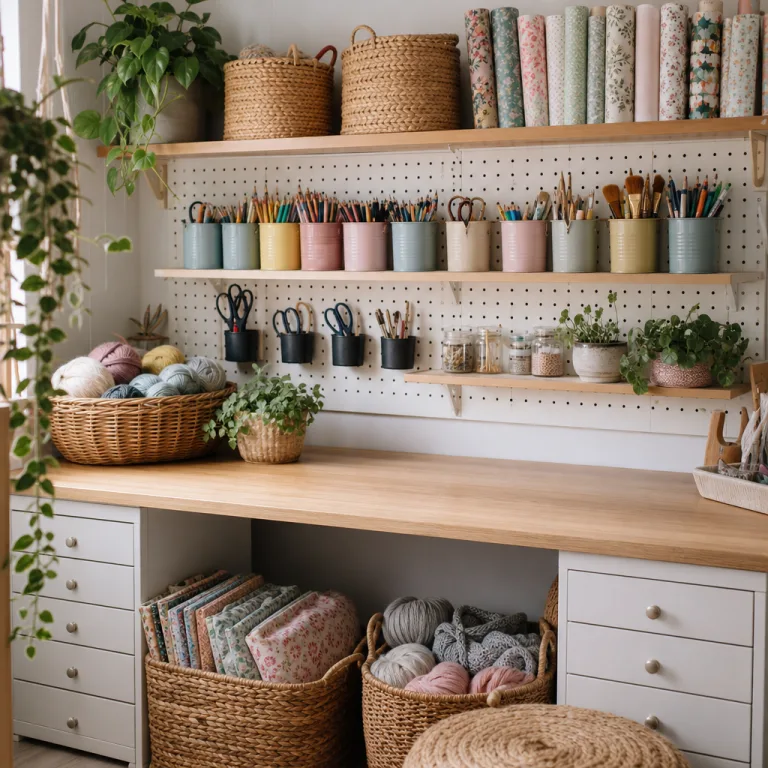
Section 2 continues the still-life philosophy by framing the bench as a small composition rather than a plain worktable. The idea is to present the sequence of activities as a visual stage: cutting, applying and finishing, each zone clearly demarcated. A low basket catches scraps and offset pieces, acting as a stage floor that keeps the surface tidy without stifling creative mess. The main tools sit in a calm order: ruler, scissors, brushes, pin box, each nook deliberately placed and easy to reach.
 Save
Save
The body then moves with intention, guided by arrangement rather than impulse. Lighting remains a companion to the layout, not a spectator, and the interplay between shadow and colour becomes part of the practice. Diffuse daylight from the north reduces harsh glare while a warm lamp on a dimmer softens edges as the project evolves. The shade rotates with the sun, nudging the moment of contact with colour toward a steady tempo.
We notice how the eye lands first on the jar of brushes, then travels to the thread box, then rests on the finished sample, guiding activity. The sequence encourages thoughtful, measured making rather than rapid completion, a habit that protects accuracy and personal pace. Storage plays a supporting role, keeping the surface clear but never bare, a quiet margin for the daily project. A shallow tray catches stray threads; a stack of flat tins holds small implements, each item with a designated home that is visible.
Materials within reach, minds at ease
Materials sit within easy reach, but not within easy reach of distraction. Labels are clear, with sizes and textures described with intention and without flourish, so the mind can orient itself quickly. A small magnetic strip holds scissors and clamps in place, so nothing travels far from the bench and nothing pushes the corner toward clutter. The arrangement reduces micro-decisions that slow the hand and stall momentum, allowing the mind to stay engaged with the task.
Proximity is paired with restraint; too many tools become a distraction rather than a resource. We count four essential tools as the rule for the week, and keep the rest in a nearby cupboard for occasional use. When tools are visible and familiar, the hand trusts what to reach for, and the body relaxes into the flow. The brain receives a signal that the task is doable, not overwhelming, and the session can unfold with quiet confidence.
 Save
Save
Colour and texture guides mirror the maker's intent. The same yarns appear in swatches and finished pieces to reinforce continuity and memory, reinforcing a sense of belonging. A single acrylic tint sits beside a natural dye and a subtle ink mark, offering options without confusion. The discipline of visibility makes learning slower and more generous, and the space rewards patience. We leave with the quiet sense that mastery is not the same as perfection.
“Colour guides the hand toward quiet confidence rather than flash.” — Mira
Lighting that softens and guides
Section 4 explores how lighting can be used as a soft guide rather than a forceful directive. Light acts as the quiet conductor of the corner, shaping how colour reads and how lines land, allowing intent to register before execution.
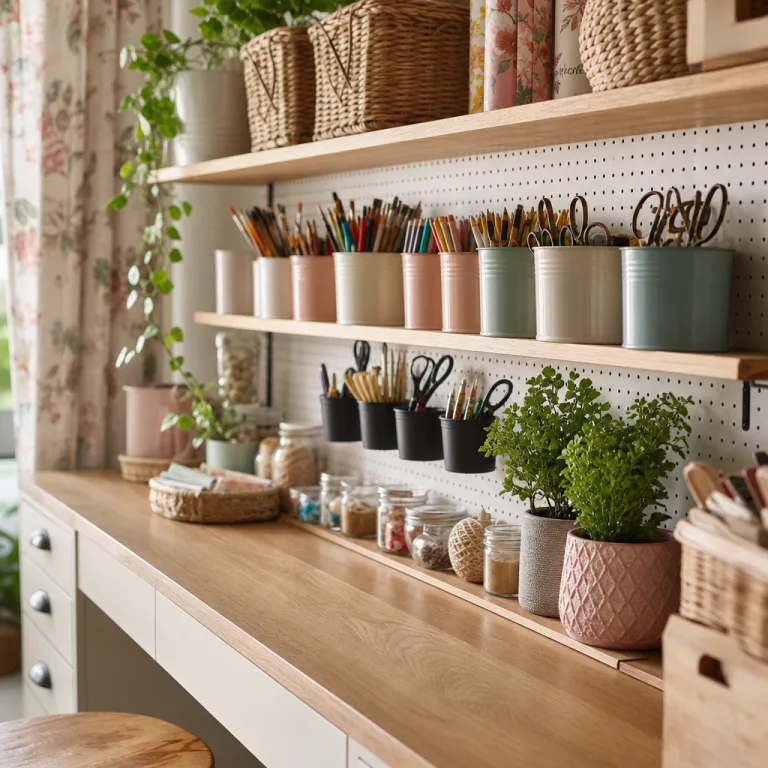
A frosted window bathes the bench in diffuse brightness, keeping shadows gentle and the eye comfortable during longer sessions. The bench edge catches a thin line of sun that marks the day without shouting, a memory of time rather than a timer. We notice how a desk lamp with a warm 2700K bulb softens edges and invites longer sessions, especially when the task requires close observation. Practical lighting also prevents mishaps and protects finished colour over multiple sessions.
The glow should feel even, not decorative; it must serve the task, supporting line accuracy and edge control. When light stays steady, a slow rhythm emerges rather than a rushed pace, and the craft corner breathes in time with the maker. Light reads differently in the late morning and late afternoon, so the maker returns to the corner to reassess shade and tone. Diffuse daylight may soften a colour that feels too bright at noon, prompting a deliberate re-layering rather than a quick fix.
 Save
Save
The glow helps identify even small flaws and uneven paint layers before sealing, which saves later remediation. We keep cords tidy and limit glare on glossy surfaces for safer handling and longer sessions without fatigue. The corner thus feels closer to a studio than to a kitchen table, and the practice gains gravity through stable light. Calm illumination becomes part of the making rhythm, guiding pace and attention.
- A dedicated tray for tools
- A small jar for water or solvent
- A note pad for quick reflections
- A colour swatch card
- A tidy bin for waste and offcuts
A moment of ritual: setting up the corner
Ritual here is simple and personal, nothing theatrical, but it anchors the day with a dependable routine. The maker begins by aligning the main tools, then checking the light and taking three slow breaths to mark readiness. A tiny bowl of water is refreshed, the jar lids are snapped closed, and a moment of quiet is allowed before the first stroke. The sequence sets a pace that honours craft as process rather than product, and the first mark feels calmer because intention precedes action.
During the session, notes are kept in a pocket notebook, not a digital device. The handwriting is neat, deliberate and legible on aged paper, and the act of writing slows the mind more effectively than any timer. When a piece moves between stages, a friendly cue on the page marks the transition, turning memory into a practical guide. The ritual becomes a memory that returns when the corner is called upon again, like a familiar tune that signals continuity.
Ultimately the corner becomes a habit, not a showpiece; consistency is the aim. With repeated use, the space grows to reflect the maker's habits and preferences, offering encouragement rather than critique. Each return revisits the same calm structure, building confidence and patience in equal measure. The memory of setup and rhythm travels with the maker, making future sessions smoother and more focused.
How to do it
Choose a gentle palette
Choose a restrained set of colours and textures that complement each other, then test on a small sample before committing to a project, allowing room for reconsideration.
Define three zones
Define three zones as cutting, applying and finishing, each with designated tools visible in the same order every session; include a soft boundary such as a taped line on the bench to reinforce routine.
Set the light
Set diffuse daylight and a warm task lamp, ensure no glare on the work surface and allowing the eye to travel along the piece without sudden contrast.
Begin with a ritual
Begin with a short breathing exercise, align the first stroke with intention, and record in the pocket notebook the mood for the session, the expected steps, and any adjustments.
Common mistakes to avoid
Overcrowding the surface
It's easy to crowd the bench with too many tools. The eye wanders and momentum stalls. We found that a single clear zone keeps attention directed and prevents spillages from turning into distractions.
Neglecting scale
We have learned to measure space before starting. Without a scale check, pieces feel mismatched, and the corner loses cohesion. Keep a small ruler and a fabric gauge visible.
Rushing finishes
Rushing coats or drying times erode colour depth. Allow layers to dry; build gradually to retain clarity and learning.
Frequently asked
What makes a craft corner calming?
Which tools are essential for a small textile corner?
How do you maintain a calm workflow?
What is the role of colour in calm creativity?
How much should you invest to start a colourful craft corner?
Where should you start when redesigning a corner?
What mistakes should we avoid in small spaces?
How do you finish a session and reset the space?
In closing
The colourful craft corner remains a quiet graduation between intention and practice, where colour is not ornament but a coordinate for slow making. We leave with a sense of continuity—every visit adds a little more order, a few more textures, and a calmer rhythm to the day. The space teaches patience without insisting on perfection, and the hands learn to listen as much as to act.