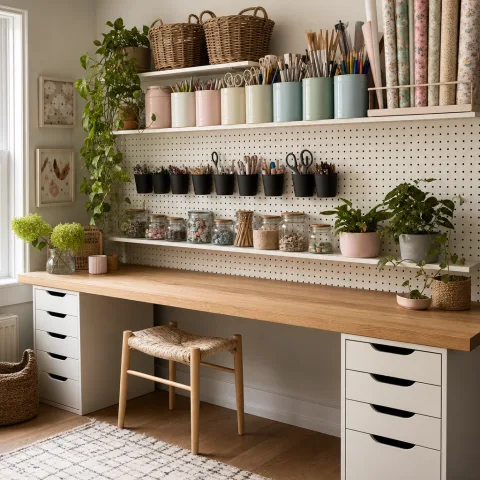
The three-legged stool is the oldest seat humans make, and the reason is geometry: three legs always touch the floor, no matter how uneven the floor is. Our kitchen floor is 1940s pine and has a gentle wave to it that no four-legged chair has ever sat flat on. The stool we built from a beech offcut one Saturday sits dead flat on every part of that floor, and in two years it has reached high shelves, seated overflow dinner guests, and held a fern by the window. It is the most-used small object in the kitchen.
Why three legs, always
Three points define a plane. A three-legged stool cannot rock, because any three feet always rest on a single flat plane no matter the floor's irregularities. A four-legged stool needs a perfectly flat floor or one leg shimmed; on an old wooden floor it rocks forever. This is not a craft preference — it is plane geometry, and it is why milking stools, which had to work on barn floors, always had three legs.
 Save
Save
The splay matters as much as the count. Legs angled outward at ten to fifteen degrees widen the stool's footprint, lower its centre of gravity, and make it stable to sit on near the edge. Vertical legs look stiff and tip easily; over-splayed legs look like a deckchair and get in the way. Twelve degrees is the number we keep coming back to — wide enough to be stable, narrow enough to be elegant.
Socketed and wedged, never screwed
The legs go into round sockets bored into the underside of the seat, and each tenon is split and wedged so it locks tight as the wedge spreads it. This joint gets stronger as the wood dries and the wedge bites deeper. A screwed leg loosens with every sit; a wedged tenon tightens. The old stools that survive a century are all wedged. The flat-pack stools with metal brackets last about as long as the warranty.
 Save
Save
“A screwed leg loosens with every sit; a wedged tenon tightens.” — Theo
Shaping the seat
A flat stool seat is fine; a slightly dished one is better. We scooped a shallow saddle into the beech with a curved spokeshave and a card scraper — maybe six millimetres deep at the centre — and the difference in comfort over a twenty-minute sit is significant. The dish takes an hour of hand work and is the single thing that turns a stool from a step into a seat. If you only do one refinement, dish the seat.
The edge of the seat gets a generous round-over, because a square edge cuts into the back of the thighs. We use a block plane to knock the corner off, then sandpaper to round it fully — about a fifteen-millimetre radius all around. The combination of a dished centre and a rounded edge is what your body reads as comfortable; neither alone is enough.
- Three legs, never four, for any seat that lives on an old floor.
- Twelve-degree splay — stable without sprawling. Use a bevel guide, not your eye.
- Wedged through-tenons, not screws. The joint tightens as the wood dries.
- Dish the seat 6 mm and round the edge 15 mm. This is what 'comfortable' actually means.
How to do it
Cut and dish the seat.
A beech slab roughly 30 cm across, 4 cm thick. Scoop a shallow saddle with a curved spokeshave, 6 mm at the centre, blending to flat at the edges. Round the perimeter to a 15 mm radius.
Bore the leg sockets.
Three 25 mm holes in a triangle on the underside, drilled at twelve degrees of splay using a bevel guide. Equal spacing — mark a circle, divide into three with a compass.
Turn or shave the legs.
Three legs about 45 cm long, tapered slightly toward the foot. A lathe is ideal; a drawknife and spokeshave work fine. Cut a tenon on each top end to fit the sockets snugly.
Wedge and level.
Saw a slot in each tenon, drive the leg home, then drive a glued wedge into the slot across the seat's grain. Trim the legs to length on the floor so the stool sits dead level, then oil.
Frequently asked
Do I need a lathe?
What wood is best?
How tall should it be?
Will the wedged joint ever loosen?
Can a beginner make this?
What finish?
How do I get all three legs the same length?
In closing
The stool is the oldest seat there is, and the reason it has survived ten thousand years unchanged is that three legs solve a problem four legs create. Ours came from an offcut and an afternoon, sits flat on a floor no chair can manage, and does five jobs a week. The best small carpentry solves an old problem with an older answer.