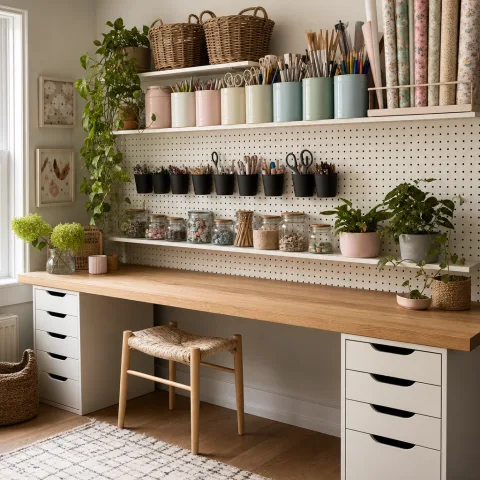
There is a particular type of small joinery project that is too humble for a magazine and too useful to skip. A spice cabinet is the canonical example. Ours sat on the to-do list for fourteen months, then a wet Saturday in February cleared the morning and the plank was already in the workshop. By dinner the cabinet was hung. By Sunday lunch every spice we owned had a home.
Why a plank, not a kit
A flat-pack spice rack costs twenty euros and is made of plywood that smells like glue for a year. A single plank of European beech, planed and dovetailed, costs about the same and lasts three generations. The argument for a kit is that it is faster. It is not, by much. The dovetails take an hour. The kit takes forty minutes of unpacking and the rest of your life of regret.
 Save
Save
The other reason is fit. A kit cabinet is a fixed depth, fixed shelf height, fixed jar diameter. Real spices come in nine different jar sizes. Building your own means you cut the shelves to the jars you actually own, leave room for the one that is taller (smoked paprika, in our case), and the cabinet ends up using its volume.
Cutting the dovetails
Twelve dovetails is twelve. Three on each corner, four corners, an hour at the bench if you have done a few before, two hours if you are learning. The trick is to mark with a knife, not a pencil — pencil lines blur, knife lines never lie. Cut on the waste side of the line, pare back to it. The first one is wonky. The twelfth is straight. The cabinet does not mind the wonky one; it is on the back, where it lived a wonky life and never told anyone.
 Save
Save
“The first dovetail is wonky. The twelfth is straight. The cabinet does not mind.” — Theo
- Use a marking gauge for the baseline. A pencil line is a fact; a knife line is a contract.
- Cut every tail before any pin. Reverse the order and you spend the day correcting yourself.
- Dry-fit twice before glue. Glue-up twenty seconds is fine; glue-up wrong is forever.
- Beeswax over varnish. The cabinet lives in steam; varnish flakes, wax breathes.
How to do it
Plane the plank to 14 mm.
Reduce the rough beech to a clean 14 mm. A jack plane and forty minutes; an electric planer and ten if you own one. Either way the surface is hand-finished with a card scraper.
Mark and cut the case.
Two sides, two tops, three shelves, one back. Crosscut on a sled, plane the ends to true. The back is rebated 6 mm for a thin shiplap panel — no plywood, ever, anywhere near food.
Cut and chop the dovetails.
Tails first, transferred to pins with a knife. Saw on the waste side, chop with a 6 mm chisel. Glue with hot hide glue or PVA — both reversible if a future you wants to repair.
Wax and hang.
Two coats of beeswax, buffed with a soft cloth between. Hang on a French cleat — the cabinet lifts off in five seconds for a deep clean once a year.
Frequently asked
Why beech and not oak?
How big should each shelf be?
Can I use the same design for tea?
What if my dovetails come out badly?
In closing
The cabinet has been above the hob for two years. The beech has darkened a tone. The wax needs a refresh in October and again in March. The dovetails are still tight. The smoked paprika still does not quite fit and we have not bothered to fix it. There is a small joy in making the things you use every day, and joinery is the cheapest one I know.