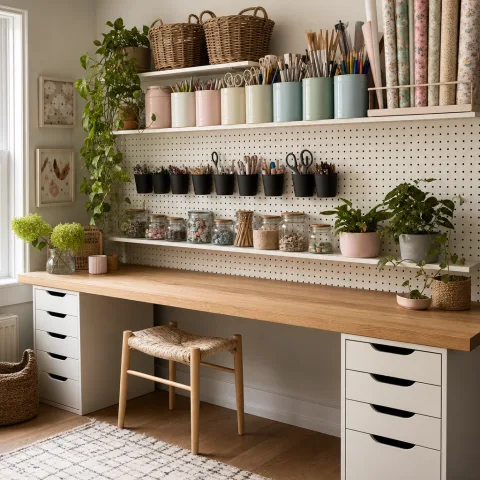
We have hung a lot of shelves and bowed most of them. The cheap floating kind, with a concealed rod and a hollow board, look clean for a month and then sag in the middle like a hammock the moment you fill them with anything heavier than a candle. The salvage yard cured us. Two hand-forged brackets and a thick reclaimed scaffold board later, we have a shelf that carries a full row of hardbacks across more than a metre without a millimetre of droop, and we finally understand why the expensive-looking shelves were the ones that failed.
Why visible brackets win
A floating shelf hides its support inside the board, which means the entire load is carried on a short steel rod cantilevered out of the wall. The leverage is brutal: a book at the front edge multiplies its weight against that rod many times over, and the board, hollowed to hide the rod, has little stiffness left to resist. It is a design that prioritises looks over physics, and physics always collects its debt.
A visible bracket carries the load along its full diagonal, transferring weight down into the wall rather than levering against a single point. It is honest engineering you can see, and the honesty is part of the charm. A hand-forged bracket is not a thing to hide; it is the reason the shelf works.
 Save
Save
Reading a salvage board
Reclaimed scaffold boards are the unsung hero of cheap, stiff shelving. They are 38 mm thick, already seasoned by years outdoors, and stiff enough to span a metre without help. They carry nail holes, paint flecks and the soft grey of weathering, all of which read as character once the board is sanded and oiled rather than sins to be planed away.
We sand only enough to take off splinters and the worst of the grime, then feed the wood with a single coat of hardwax oil. Over-sanding a scaffold board turns it into an anonymous plank; the goal is clean to the touch but still clearly a board with a past.
 Save
Save
“It is a design that prioritises looks over physics, and physics always collects its debt.” — Theo
Into the wall, into the studs
A loaded shelf is a cantilever, and a cantilever pulls hard at the top fixing as it tries to rotate off the wall. That top screw must bite into solid timber. We find the studs, set the brackets to land on them, and drive long screws into the wood — never into plasterboard alone, where a loaded shelf will slowly lever the anchors out and then drop a row of books on your foot.
Spacing is the last detail. Brackets a third of the way in from each end resist both the centre sag and the end droop, the two failure modes of a long shelf. It is the same rule we use for everything that spans, from shelves to worktops, and it has never let us down.
- Buy brackets by the pair from salvage — heavier carries more.
- Scaffold board at 38 mm spans a metre without sag.
- Top fixing into a stud; the cantilever pulls hardest there.
- Brackets a third in from each end beat sag and droop together.
How to do it
Pick the brackets and board.
A matched pair of forged brackets and a scaffold board cut 100 mm wider than the bracket span. Sand to clean, oil once.

Find the studs.
Detector and bradawl. Set the bracket positions to land on solid timber, a third in from each end of the board.
Mark, drill, fix.
Mark through the real bracket holes, drill pilots into the studs, drive 80 mm screws. Check level across both brackets before the final turn.
Drop the board on and load slowly.
Rest the board, screw up into it from under the brackets, then load from the ends inward. Watch for any movement before trusting it fully.
Common mistakes to avoid
Trusting plasterboard anchors
The single most common failure. A loaded cantilever levers anchors out of plasterboard over weeks, then lets go all at once. Always reach a stud for the top fixing, even if it means moving the shelf a few centimetres.
Over-sanding the board
Sanding a scaffold board back to bare bright timber throws away the entire reason to use reclaimed wood. Clean off splinters and grime, then stop. The grey and the marks are the character you paid nothing for.
Centring the brackets
Brackets set too close to the middle leave the ends drooping; set at the very ends they leave the centre sagging. A third in from each end is the spacing that resists both at once.
Frequently asked
Do salvage brackets come in matched pairs?
How heavy a load can this really hold?
Can renters do this?
Do I need to treat the iron?
What if there's no stud where I want the shelf?
Scaffold board or oak?
How do I clean the board safely?
In closing
The shelf has carried the same heavy row of books for a year without a sag, because the brackets are doing visible, honest work instead of hiding a doomed steel rod inside a hollow board. Eighteen pounds at a salvage yard taught us more about weight than every flat-pack shelf we ever bowed.