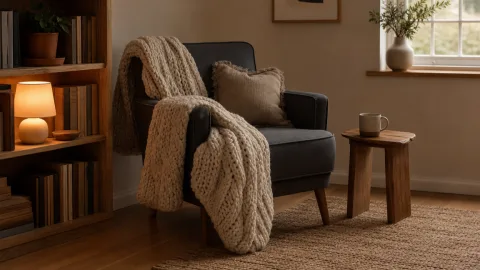
We owned the right lamp and put it in the wrong place for three years. It stood in front of the chair, throwing light at our faces and leaving the page in our own shadow, and we blamed the bulb, the chair, even the books. The fix was not a new lamp; it was thirty centimetres and a rule. Moved behind the reading shoulder with the bulb at seated head height, the same lamp turned a squint-inducing corner into the seat the whole household now competes for after dinner.
Why behind the shoulder
A reading light has one job: to land on the page without landing in your eyes or being blocked by your own head. Place a lamp in front of you and you get glare and a shadowed page, because your head is between the light and the book. Place it behind your shoulder — the dominant side, the hand you hold the book toward — and the light arrives over your shoulder onto the page, exactly the path daylight from a window takes when reading feels effortless.
It is the same principle as a desk lamp coming from the side opposite your writing hand: light should approach the work from behind and to the side, never head-on. Once you feel the difference you cannot unsee the years you spent reading in your own shadow.
 Save
Save
The bulb and the shade
Warmth matters as much as position. A 2700 K bulb gives the soft, slightly amber light that reads as evening and is kind to tired eyes; a cool 4000 K bulb feels like an office and fights the mood of a reading corner. Dimmable is worth the small premium, because the right brightness for a bright novel is not the right brightness for falling asleep over poetry.
The shade should be open at the bottom and ideally the top, directing a column of light down onto the page while letting a little spill up to soften the room. A fully enclosed drum aimed sideways lights the wall and not the book. Angle the opening down and slightly forward toward where the page will be.
 Save
Save
“You cannot unsee the years you spent reading in your own shadow.” — Mira
The rest of the corner
With the light right, the rest of the corner falls into place. A small table within reach of the dominant hand for a mug and the book you are not currently holding; a chair with a back that supports the shoulders upright rather than reclined flat; and a second, dimmer ambient light somewhere else in the room so the reading pool does not sit in pitch black, which tires the eyes through contrast. None of it is expensive. All of it is position.
The lesson generalises beyond reading. Most lighting complaints are placement complaints wearing a costume — people buy brighter bulbs to fix problems that a thirty-centimetre move would solve for free. Get the position right first, then choose the bulb.
- Lamp behind the dominant-side shoulder, never in front of the page.
- Shade bottom at seated head height for glare-free light on the book.
- 2700 K, dimmable, in an open-bottomed shade aimed down and forward.
- Add a dim ambient light elsewhere so the page is not an island in the dark.
How to do it
Sit and find your reading shoulder.
Hold a book as you actually read. The hand you angle it toward is your dominant side; the lamp goes just behind that shoulder.

Set the bulb to seated head height.
Adjust the lamp so the bottom of the shade is level with your head when seated. Higher glares; lower pools on the chair arm.
Fit a warm dimmable bulb.
2700 K, dimmable. Aim the shade opening down and slightly forward toward where the open page will sit.
Add a dim ambient light.
A low lamp elsewhere in the room softens the contrast so your eyes are not jumping between a bright page and a black room.
Frequently asked
What if I read on both sides of the chair?
Floor lamp or table lamp?
What wattage equivalent?
Why does my page still shadow?
Is cool white ever right for reading?
Does the chair really matter?
Can one lamp do a whole reading corner?
In closing
The lamp never changed and the books never changed; only the position did. Behind the shoulder, bulb at head height, a warm dimmable bulb aimed at the page — and a corner we used to avoid is now the chair we argue over. Most lighting problems are placement problems, and placement is free.