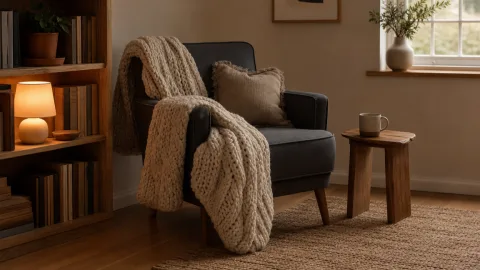
The chair arrived one rainy Saturday in a plastic bag of other people’s decisions. It was the sort of thrift‑store find that needs to be seen hunched over a list of compromises: a cane seat with a small strand broken on the edge, one leg with an old screw and a little wobble, a frame that had the kind of scratches that read as history rather than neglect. We pushed it into the smallest corner of the front room — there was only room for a person and a lamp — and for the first week it felt like a temporary joke. Then we put a low table next to it, the kind of table that insists you lower your demands and raise your attention. We added a brass swing‑arm lamp so late emails and pages could be read without everyone else in the apartment knowing, and a corner that had been wasted became, absurdly, our office.
How we found the chair
There’s something modestly theatrical about the moment a chair chooses you. Ours was tucked behind a rack of linen shirts at a neighborhood thrift shop, half hidden, as if it were shy about how well it had been used. The cane seat had the faint sheen of hands and knees: not new, but not abused. We could have left it for someone who wanted a full dining set or a pristine midcentury find, but that’s the thing about tiny corners — they reward odd fits. A chair that reads as slightly too old looks right when squashed into a skinny space beside a lamp and a stack of books; newness would read as noise.
We took it home for less than thirty euros and a promise to ourselves: mend what’s mendable, don’t replace what can be fixed. The first evening was spent at the kitchen table with sandpaper, a jar of linseed oil and a small clamp that cost as much as a cheap pizza. The broken cane strand was eased back into place and woven with a length of replacement cane I ordered online; the wobble in the leg was eliminated with a little epoxy and a brass brace we made from a dowel and a strip of leather. Repairing the chair was almost as much a part of making the corner as choosing a lamp — the work makes the object feel like ours, not borrowed.
The thrift that stuck
Not every thrift find survives the first week at home. The chair that stays is the one that makes you notice its small flaws as you sit down rather than as defects. For us, the cane’s missing strand and the faint ring of a coffee cup on the arm read as proof that the thing had already been used thoughtfully. Buying secondhand is part bargain, part deliberate deceleration: it forces choices that favor repair and rearrangement over replacement. If you are hunting furniture for a micro corner, take a moment to sit, to test the scale and the comfort. A chair that requires a small fix is often better than a pristine one that feels alien in your room.
Repair, not replace
The repair took an afternoon and two weekends. We kept the costs low: replacement cane webbing, a small tube of wood glue, a clamp and a can of oil finish that will last years. The real cost was time and attention, which is to say we learned the chair’s particular voice: where it creaked and when the joint felt soft. There’s a quiet, stubborn pleasure in keeping a thing serviceable; it teaches restraint. Mending the chair made us more likely to sit in it, which in turn changed how the corner felt to us and to guests. A good fix often unlocks more use than a perfect purchase.
Sizing the corner
There is a particular joy in learning the language of a small space: the way a centimetre matters, how a gap reads as invitation or neglect. Our corner measures roughly 1.2 square metres — a sliver by most standards — and that meant the chair could not be bulky, the table could not demand a lamp base, and every cord needed to be thought through. We learned early on to measure with the chair in mind, not the table. Sit where you want to sit, then measure outward for surface and illumination. That order keeps the primary activity — sitting and reading or writing — honest.
The oak side table we chose is only 38 centimetres tall. That low height creates an important conversation with the chair: when your elbow lands on the tabletop the angle of your arm is natural and you don’t have to hunch. Taller tables in tiny corners force posture into awkward geometry. We tested the table height with a stack of books before we committed — the cardboard box technique is not glamorous, but it lets you live with a height for a week before buying anything. Measure twice; live with a mockup for a few days. A corner needs breathing room as much as a room does.
Measure like a woodworker
We measure twice and think once. Because the space is so small, millimetres matter: the chair’s back had to clear the radiator, the table needed a 6 cm gap to allow a hand to pass, and the swing‑arm lamp needed an arc that wouldn’t catch on the curtain. A cheap digital tape measure and a notepad are the best purchases you’ll make for a corner project. Sketch the corner in plan view; mark the swing radius of any lamp and the footprint of the chair. The practice removes a lot of guesswork and reduces returns, improvisation and the eventual accumulation of stuff in the wider room.
Leave breathing room
A corner that looks crowded at first often benefits from subtraction rather than addition. We kept a 4–8 cm gap between furniture and walls so shadows could do the architectural work and the space would read as intentional. Breathing room also matters for cleaning and small acts of care: a sliver of space saves you from needing to drag the chair across the room to sweep. In a rental, these small practicalities compound; a well-considered gap prevents scuffs and allows for simple maintenance without reverse-engineering the room every time.
 Save
Save
Why a low table matters
The table’s height determines how the corner feels in practice: it mediates posture, breath and the relationship between hands and objects. Low tables encourage a less formal, more sustained sitting — the kind of posture that keeps your shoulders relaxed while you reach for a notebook. Taller side tables are not wrong, but in a narrow corner they create a vertical tension that can make a small space feel crowded and performance‑oriented. We chose low on purpose because the corner is for long, quiet sessions rather than quick standing checks.
Material matters as much as height. Oak, with its forgiving grain and warm tone, reads as calm rather than precious. We avoided veneer and cheap composite because a scratched veneer shows wrong in a tiny corner — it tells a story of cost-cutting. Solid wood wears into itself and responds to small repairs: a sanded ding, a rubbed oil finish, these become part of the room’s language. The table we chose was inexpensive but honest: solid top, simple joinery and a small nick you can feel more than see.
Surface, posture and proportion
The tabletop is a negotiation between the needs of the body and the small rituals of reading: a place for glasses, a notebook, a mug. We kept the surface deliberately small so it wouldn’t encourage piles. There’s a practical benefit: small surfaces force decisions. Put only the book you’re reading, a lamp that doesn’t demand a lamp base, and perhaps a small plant. That minimalism is not a style choice as much as a behavioral design: fewer objects lead to fewer distractions, which in turn translates into more finished pages and fewer half‑started drafts.
Materials that age well
Spend where repair is possible and where a mark will make the piece better, not worse. Solid wood, brass fittings and natural textiles all patina honestly. Plastic and laminate, on the other hand, tend to scream their cheapness in small corners where every surface is read closely. A few euros more on a table made from good wood can save you from replacing it in five years, especially in a rental where a robust piece can be slid from corner to corner and still feel right. Durable materials pay back in fewer decisions later.
Lighting: one brass swing-arm lamp
We could have used a floor lamp but the swing‑arm wins in small corners. It lives on the wall where it takes up no floor space, and its arm folds back when you want the corner to be simply a silhouette against the room. We chose brass because it reads warm in low light and because it can be matched cheaply with a lamp fitter rather than by hunting a particular shade. The lamp’s real value is functional: it must reach over the head of a seated person and cast enough light on a page without washing the corner in glare. That balance of reach and control is what makes a wall lamp useful.
Mounting a wall lamp in a rental requires small acts of diplomacy. We placed the bracket into a stud where possible, and where that wasn’t an option we used heavy‑duty wall anchors that can be removed later with minimal damage. The bracket sits a little higher than the chair head so the arm clears the back when retracted. A retractable arm matters because it lets the lamp be both functional and discreet; at night we fold it in so the corner becomes a vertical painting rather than a reading station. Good placement is invisible in use but obvious when done wrong.
Mounting and reach
Before drilling we marked the swing radius on the wall with masking tape and sat in the chair to test where the light would fall. The lamp needed to be high enough to clear the chair back when folded and low enough that its downward throw would land on a page. If you can’t hit a stud, use molly bolts or hollow-wall anchors that match the weight rating of the fixture. If you rent, photograph the process so you can show your landlord what you did when you move out — it makes reversibility easier to explain and often keeps security deposits intact.
Bulb choices and colour temperature
We use a warm LED in the lamp: about 2700–3000K. Cooler temperatures are crisp but make a small corner feel clinical; warmer light is forgiving, shows off wood and brass better and helps the eyes relax for longer reading stints. Choose a bulb with a high CRI (90+) if possible so colours render more honestly on the page. A dimmable bulb is a small luxury: it lets the lamp be bright enough for writing and soft enough for an evening of fiction. The bulb is cheap relative to how much it changes the corner’s temperament.
 Save
Save
Textiles, a rug and the small things
Textiles turn a corner from functional to hospitable. We chose a small, flat‑weave rug under the chair to anchor it visually and to catch crumbs and dust so they don’t travel across the living room. A rug pad keeps the rug from shuffling and protects the floor beneath — the small expense is worth it. Pillows and a thin throw give the chair a softer back and a place to rest a hand between pages. Textiles in a narrow corner should be modest: one small rug, one throw, one lumbar pillow. Too many layers conspicuously clutter a tiny area.
We avoided plush, high-pile rugs because they steal attention and trap dust. A low-profile jute or flat woven wool rug wears well and slides under a small table without looking like an afterthought. We also prefer natural fibres in small corners because they accept oil finishes and stains in a way synthetics don’t; a linen throw with a patch sewn onto a worn spot reads as intentional rather than missing. Small acts of mending — a visible stitch on a throw — are part of the aesthetic and the ethics of living with less.
Rug scale and underlay
Rug size matters more than pattern in a corner. Too large and it competes; too small and it looks accidental. Ours is just large enough to hold the chair and table legs and to leave a 5–7 cm margin around the edges. The underlay is essential — a thin non-slip pad prevents the rug from bunching and protects the floor from abrasion. In a rental, that small investment also reduces the likelihood of scuffs when the chair rubs during use.
Pillows and mending
We like a single small lumbar pillow with a linen cover that has been darned in one corner. The visible repair makes the pillow less precious and more useful; it also sets a tone for the corner that values longevity. Sewing a small patch or running a neat darning stitch takes thirty minutes and changes how you treat an object. It sounds sentimental, but people behave differently around things that show care. If you prefer not to visibly mend, choose a cover that hides wear — but if you can spare the time, a repair often outshines a replacement.
- Small flat-weave rug (just big enough for chair and table)
- Thin rug pad to prevent slipping and protect the floor
- Linen throw with visible mending for durability and texture
How this corner survives a rental
Rentals are an argument against permanence; they reward reversible interventions. We treated our corner as a series of temporary choices, each one made with the idea that it should leave the space as good as we found it — or better. The lamp mounting used anchors rated for the fixture and photographic documentation; the table has felt pads under its feet; the rug pad is non-adhesive. Those small investments are about leaving fewer marks and reducing friction at the end of a tenancy. They also make the corner adaptable: if we move, it slides into a new space without drama.
We kept a kit — a small box of replacement wall anchors, a tube of filler, a can of touch-up paint matched to the wall, and the receipt for the lamp bracket — precisely because good documentation makes the eventual unmaking painless. Photograph where things are installed, keep receipts and, when possible, ask the landlord about stud locations before you drill. If permission is uncertain, consider a clamp‑on lamp or a freestanding arc lamp that can sit behind the chair. There are always reversible options; the trick is to plan for them before you commit.
No-drill tricks
If drilling isn’t an option, think laterally. A tall, thin floor lamp with a weighted base can tuck behind the chair and provide similar directional light. Command strips and picture-hanging hooks have improved and can hold lighter fixtures; check weight limits. A clamp light fixed to a shelf above the chair can work without touching the wall. The goal is to achieve the same patterns of light and usability without permanent change. Often the reversible option is also simpler to maintain and less aggressive in a small space.
Reversibility and adhesives
Use felt pads and non-marking rubber feet on legs, avoid double-sided tape directly on painted walls and keep paint touch-up in the kit. When adhesives are necessary, choose low-tack varieties and read removal instructions. The cumulative effect of reversible choices is less wear on the space and fewer headaches at the end of a lease. Reversibility is not the same as avoiding effort; it’s a framework for choosing interventions that respect both your needs and the property you occupy temporarily.
 Save
Save
Working there: our rituals and mistakes
We discovered quickly that the corner shapes behavior as much as behavior shapes the corner. The ritual of making tea, placing a small notebook on the table, and turning the lamp on creates a psychological boundary between ‘kitchen time’ and ‘work time’, even when those activities happen in the same room. Rituals do the heavy lifting of habit formation; the physical objects are anchors. Equally important are small constraints: we don’t allow a laptop charging cable to trail across the living room, and we keep a single small notepad for ideas that may otherwise drift away. Those constraints protect the corner from entropy.
Mistakes taught more than successes. For a week we added a stack of magazines and a larger lamp because we thought more light and more reading material would be better. The corner turned into a staging ground for things we meant to get back to and the chair began to read as a repository for half-done projects. We pared it back: one lamp, one table, one chair and one small pile of current books. The corner’s usefulness is inversely proportional to the number of things it stores.
Why the ritual matters
The ritual is less about performance than signal. When we make the same small sequence — tea, lamp, notebook — our minds stop negotiating whether to start. The corner becomes a cue. Small rituals reduce decision fatigue and create a threshold that’s easy to cross. A chair with a story, a table for necessary objects, and light that invites focus: together they form a simple ecosystem that carries you to work and back to leisure without friction. It’s an economy of gestures more than an economy of objects.
When it fails: distractions and fixes
Distraction usually arrives as clutter. When the table accumulates receipts and chargers, the ritual breaks. We solve that with a small tray on the underside of the table for cables and a thin magazine folder under the table for receipts and stray papers. If a corner becomes noisy — a lamp that hums, a chair that creaks — we fix the hardware immediately. Small annoyances become excuses to abandon a space. Keeping the corner quiet, both literally and visually, keeps it useful.
“The best corners are modest in what they offer but generous in what they let you do.” — Mira
Costs: where we saved and what we spent on
There is a neat arithmetic to small corners: you can spend little in total and still end up with a meaningful place if you spend thoughtfully. Our chair was €28 from a thrift store; the replacement cane and glue were €20. The oak table was €60 at a secondhand market; the brass lamp cost €45 and a bulb €8. Felt pads, a rug pad and a small rug added another €40. In total we spent about €200 spread across a few weekends. It’s not the cheapest route, and it’s not the most expensive. It sits in the frugal middle where effort matters as much as money.
Where to save: textiles and small accessories are inexpensive and have a large visual payoff. Where to spend: on things that touch your body and that you will use every day — the chair and lamp. We could have bought a cheaper lamp, but it would have been dimmer, cheaper to replace and less consistent in colour temperature. Spending a little more on a lamp that will last reduces the chance of having to buy two or three cheaper replacements later. The cost-per-use argument is particularly compelling in corners intended for daily use.
Budget items to skimp on
Skimp safely on accessories: small decorative objects, a second throw, an extra cushion. These are visual tweaks that don’t change the corner’s function. Cheap options for textiles are acceptable if they are easily replaced and don’t trap dust or shed. If you love pattern, find a single affordable cushion cover that reads richer in contrast to plain surroundings. The principle is simple: spend where it changes how you sit and how you see.
Worthwhile splurges
Spend on the things you touch: a well-made chair, a lamp with good optics, a solid table top. These items earn their cost in comfort and in reduced replacement cycles. We also think investing in a small tool kit — a basic screwdriver set, a packet of wall anchors, a sanding block and a tin of finish — is worth it. Tools extend the life of objects and make repair accessible. In a small space, the right tool often saves you from buying new.
 Save
Save
How to do it
Choose the chair first
Sit in candidates and test scale; the chair determines posture, so measure around it before selecting table and lamp.
Mock up the table height
Use stacks of books or a box at the intended table height for a week to see how it feels with your elbows and hands.
Test the lamp swing radius
Mark the lamp's arc on the wall with tape, sit in the chair and check for glare, reach and whether it folds cleanly when retracted.
Make small repairs and add pads
Do minor chair mending, apply felt pads under table legs and a rug pad under the rug to protect the floor and stabilize the setup.
Frequently asked
Do I need to hardwire a wall lamp in a rental?
What size rug should I get for a tiny corner?
How much should I spend on a lamp?
Is repairing thrift furniture worth the effort?
In closing
If forced to condense six weeks of living into one rule it would be: choose one object that invites you to sit and then build every other decision around that inclination. We began with a chair we liked touching; the table and lamp existed to make the act of sitting sustainable and useful. Small corners answer to a different logic than rooms — they reward proportion, repair and patience rather than novelty. In a rental, where permanence is not a promise, the point is not to make the corner look like a magazine spread but to make it return you to the same quiet posture each evening. That repeatability is what turns a fragment of square metres into a place where work gets done and books get finished.