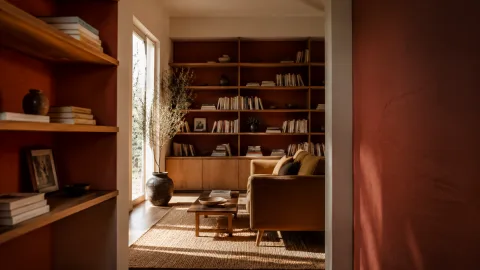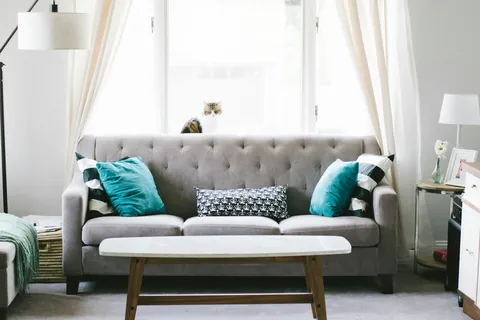
We picked a white called Alabaster from the chart and painted half a hallway with it before realising it was deeply pink. We picked one called Pure Cotton on the second go; it was deeply yellow. The third try, we did the obvious thing — painted four tester squares in the actual room, watched them across two days of natural light, and only then bought the right gallon. The right white turned out to be one we would not have chosen from a chart.
Why charts lie about white
Paint charts are printed on glossy paper, lit by daylight bulbs in the shop, and the chips are postcard-sized. Your wall is matt, in your specific room's light, and is the size of a wall. Every variable in white selection is wrong on a chart. The undertone — the subtle tint that gives a white its character — is the variable hardest to read on a tiny chip and the most dramatic on a wall. Pinks, yellows, and greens hide in plain sight.
 Save
Save
Real light is the other deception. South-facing rooms cast a warm glow that makes any cool white read as a usable warm; north-facing rooms cast cool light that makes any warm white read as a sallow yellow. The same paint on opposite walls of the same flat will read as different colours. The only way to know is to paint a square in your room and watch it for two days.
The four we tested
We tested All White, Wimborne White, Slipper Satin, and a heritage shop's house white called Linen. All White read as cold and slightly blue at midday — too clinical for a hallway. Wimborne White read as a warm cream — pretty in afternoon light, jaundiced at six in the morning. Slipper Satin read as soft taupe — handsome but more colour than we wanted. The Linen, which we had nearly skipped, read as a clean warm-neutral all day. We bought a gallon of the fourth one.
 Save
Save
“Every variable in white selection is wrong on a chart.” — Mira
- Paint at least four whites. Two will be obviously wrong; the choice is between the other two.
- Squares of 30 cm minimum. Smaller and surrounding wall colour dominates.
- Two walls per white. North vs south light reveals the undertone.
- Watch over forty-eight hours. Morning, midday, evening, lamp-on. Whites change.
How light direction changes white
North-facing rooms in northern Europe receive cool, indirect daylight all day. Cool whites read as green-grey in this light, almost cement. Warm whites with a yellow undertone correct the cool cast and read as a clean neutral. South-facing rooms have the opposite problem — warm light all day makes warm whites look creamy or yellowed, while cool whites read as honest white. East-facing rooms are warm in the morning, neutral by midday, dim by evening; west-facing rooms are dim in the morning and dramatically warm by sunset.
What this means for testing: you cannot test north-room whites in a south-facing kitchen even if both rooms 'have natural light'. Every test square has to be in the actual room you intend to paint, on at least two of the room's walls, and watched at the times of day you actually use the room. We learned this on the second go, when a kitchen white that read perfectly in the hallway turned out to be deeply yellow under the kitchen's south-facing light.
Artificial light matters as much as daylight. A 2700 K bulb makes any white warmer; a 4000 K bulb makes any white cooler. Most homes use 2700–3000 K bulbs, which means the cool whites that look correct in the daytime can read as bluish under the lamps. Add a small lamp test to your forty-eight-hour observation window, and pick the white that survives both daylight and lamp-on without losing its character.
How to do it
Buy four testers in advance.
Five-euro pots, fifty millilitres each. Range — one warm white, one cool white, one heritage, one trendy. The point is contrast, not consensus.

Paint four squares.
Two coats. Label each below with a pencil note of the brand and shade. Apply on at least two walls in the room you intend to paint.
Wait two days.
Look in morning daylight, midday, evening, and after lamps come on. Most whites lose at one of these times — that is the one you do not buy.
Buy a gallon of the survivor.
Same brand, same shade, eggshell finish. Test pots and gallons sometimes drift slightly between batches; paint a small overlap with the gallon and the tester to check before committing.
Frequently asked
Why eggshell, not matt or satin?
What if all four whites look the same in my room?
How many testers is too many?
Can I save tester pots for later rooms?
What if I'm choosing for a rental?
Should I match the trim to the wall?
Why not just pick the white the magazine featured?
In closing
The hallway is now the right white. We have a small drawer of partially-used tester pots that will be tested in other rooms over the next year, because every room takes white differently. Forty euros of testers has saved approximately three hundred in wrong gallons over the years. Watching paint dry has been the most useful homework we have ever done.