We thought we wanted a beautiful chair. What we actually wanted was a chair we would use. Those are not the same thing, and the gap between them cost us five returns and four months of credit-card credits before we figured it out. The chair that has lived in our corner for two years is not a beautiful chair. It is a deeply correct one. The lesson, in retrospect, was that reading chairs are about geometry, not photogenics.
What an actually-sat-in chair has
Three numbers and one feeling. Seat depth somewhere between forty-six and fifty-two centimetres — deeper than a dining chair, shallower than a sofa. Seat height between forty-two and forty-eight centimetres — high enough to stand from without effort. A backrest that supports your shoulder blades when your spine is mostly upright. And the feeling: when you sit in it for the first time, you do not want to get back up to do something else. That last is the only test that matters.
 Save
Save
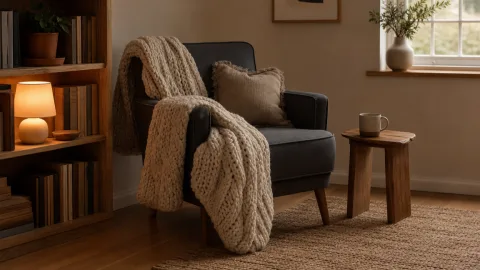
Most photographed chairs fail two of three. Mid-century lounge chairs are too low for reading — your knees come up too high and your book lands in your lap. Modern accent chairs are too shallow — you slide forward in fifteen minutes. Designer wingbacks are usually too tall on the seat. The chair we kept is a 1970s leather wingback with a forty-eight centimetre seat, fifty centimetre depth, and a back that scoops a tiny amount inward. It looked dowdy in the photograph; it has lived its second life in our corner.
Lamp and table — the rest of the geometry
A reading chair without a reading lamp is half a chair. The lamp goes behind the chair on the dominant-side shoulder, not in front. The table goes within reach of the dominant hand. The table must be big enough for a mug, a book, and a small lamp — that is roughly thirty by forty centimetres, no smaller. We tried smaller and lost a coffee to gravity within a week.
 Save
Save
“Reading chairs are about geometry, not photogenics.” — Mira
- Seat depth between 46–52 cm. Deeper feels like a sofa; shallower feels like a hotel.
- Seat height between 42–48 cm. The first thing your body does in a chair is leave it. Make leaving easy.
- Backrest scooped, not flat. A flat back fights your spine after twenty minutes.
- One material at most — leather or fabric, not both. Two materials read as a sales catalogue.
How to do it
Measure where the chair will go.
Tape on the floor, three sides of a rectangle, the chair's exact footprint plus 10 cm of breathing room. Live with the tape for two evenings.

Buy second-hand first.
Marketplace, vintage stores, estate sales. The chair you actually use is almost always twenty years old. Twenty-year-old chairs have been broken in by other people for you.
Match the lamp to the chair, not the room.
A floor lamp behind the chair, the bulb at shoulder height when seated. Warm bulb, around 2700 K. Dimmer if you can.
Live with it for a week before fitting it in.
Move other furniture around the chair, not the chair around the furniture. The chair tells the room how to behave, not the other way.
Frequently asked
Wingback or armchair?
How much should I spend?
What if I share with another reader?
Footstool?
In closing
The corner has a chair, a lamp, a table, and a piece of life. We have read more books in two years than the previous five. Whether the chair caused that or coincided with it, I cannot say. I can say that the chair has earned its corner, and that the corner is a place this flat did not have before.