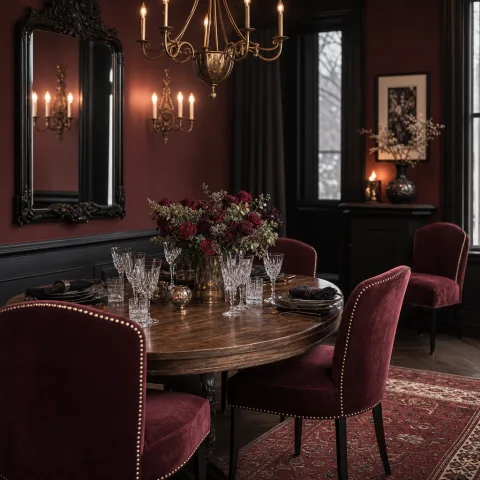
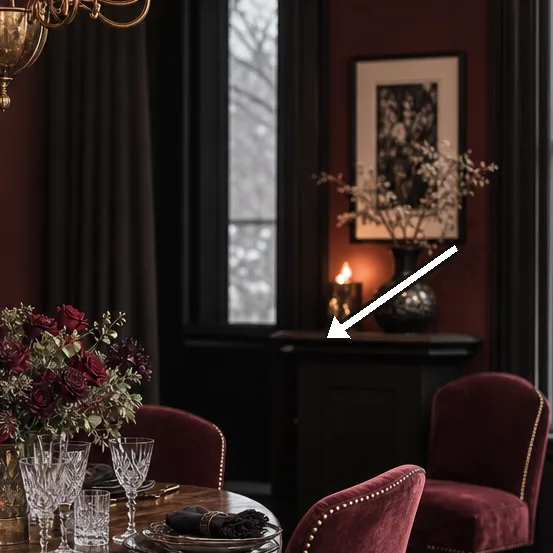
On arrival we pause at the doorway to gauge the room's proportions before touching anything. The dining room sits at the core of the house, with tall ceilings and a floor of wide oak boards. Burgundy walls carry a soft matte finish that absorbs light rather than reflecting it. The velvet of the chairs, deeper than the walls in certain lights, invites a closer look at nap and pile. A black dining table anchors the arrangement, its lacquer a counterpoint to plush upholstery, while brass pulls glow softly. We note the rug's size relative to the chairs and the window's edge - how patterns repeat rather than shout. Our photography is careful, seeking true colour rather than glamour. Patina on brass hardware softens corners that might otherwise feel hard.
Velvet as the room's heartbeat
We begin with the dining chairs, their cushions dressed in burgundy velvet that catches the late afternoon sun in ribbons of wine and plum. The nap surface is soft but resilient, showing signs of gentle use rather than heavy wear. The chairs' backs curve with a subtle saddle shape that keeps posture comfortable during long meals. The arms offer a handhold of brass-tipped wood that feels substantial in the palm, a quiet gesture of craftsmanship. We measure the distance from table edge to wall, noting how circulation remains generous even when the table is set for six. The light falling on the fabric reveals subtle reflections that change with the viewer's angle, a reminder of velvet's depth.
The grain of the dining table shows years of use; light scratches bend like topographic lines where hands have rested. The body of the chairs reveals stitching that has softened rather than frayed, suggesting solid traditional construction. We examine the velvet seat fronts, where the nap has a slight clockwise patina from years of polish and passage. The colour shifts as we move around the room, sometimes more wine red, sometimes almost black plum. These shifts remind us depth is a conversation between light, fabric, and finish rather than a single shade. The table's edge carries a faint glow along lacquer, which helps it feel simultaneously robust and refined.
It is the space between the table and the walls that convinces us this is vintage rather than staged. A flat-woven rug underfoot softens traffic and absorbs echoes without dulling the edge of the black table's gloss. The pattern, if any, remains muted - tasselled borders and a subtle loop that picks up reflected light. The combination of velvet and rug texture creates a quiet cadence, not an obvious focal point. The overall effect is something we can live with daily, not just for guest evenings. When we stand back, the room feels balanced, like a sentence left unfinished, inviting your own completion.
The burgundy palette: warmth and wear
 Save
Save
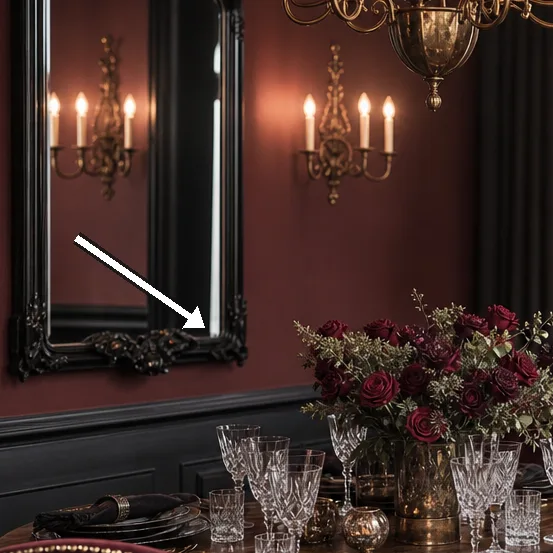
The burgundy on the walls reads softer than the fabrics and tapestries; it absorbs the room's light and returns it with a burnt edge. We note the colour balance between wall and velvet; the wall colour acts as a neutral counterpoint, allowing the fabric to breathe. On close sight, the plaster texture and subtle cracks add stories, the sort of detail that fades on a glossy surface but becomes character here. The room's palette feels curated rather than forced, with black accents doing the lifting rather than loud contrasts. In planning meals, this balance prevents the space from feeling theatrical. The wall's finish softens the room's silhouette and gives the velvet room to breathe.
The burgundy rug's fibres echo the burgundy tone, so sits cohesively with chair cushions. We observe the way the black lacquer on furniture refracts light and highlights the nap's shimmer. The nap's depth is shown not only by colour but by how it catches and re-radiates warmth from lamps. When the room is sketching its mood, the nap’s depth reads differently across the day, shifting with your gaze. We test small swatches against wall, table leg, and brass rail to verify that depth remains stable across the room. The velvet's sheen appears as a soft halo when the lamp is low, not a brash glare.
The chair legs and table edge are trimmed in warm oak, while the hardware shows a patina of age. The brass pulls glow softly, showing wear where oils have rubbed. We wipe a small corner with a felt cloth and watch the shine settle into a pleasant dull glow rather than bright glare. The effect is a sense of quiet regression to a period when furniture was built to age gracefully. Across the room, the balance between gloss and fibre becomes the room's sentry. The timber's grain is visible at floor level, adding a tactile punctuation to every step.
Textures under glass and brass
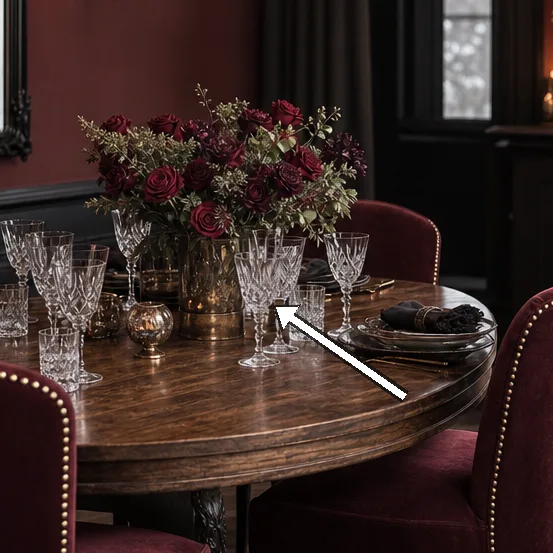
In this room, the tabletop's glass top softens the table's heaviness, allowing the black lacquer to breathe. Under daylight the brass handles catch a warm highlight; at night, they glow like embers. The nap's direction matters; we test the fabric's response to swats from different angles, noting how the pile lays in a gentle arc. The contrasts among smooth glass, lacquer, and velvet create a rhythm that invites touch rather than glare. We watch how the light plays along the nap, revealing depth rather than flattening it. The room seems to breathe as the surface tension between materials shifts with temperature and humidity.
 Save
Save
We observe the chair backs again, the brass rails catching the light in shifting ways as people move. The velvet's nap gathers occasional velvet dust; we note that the pile's sheen is variable but pleasant. Small investments in brushes and a soft vacuum maintain the fabric's quiet finish. The room feels as if it could wear with time and still hold its mood. We test the seating's responsiveness when multiple guests gather, ensuring comfort persists. The overall impression is one of relaxed luxury that remains practical for daily use.
The floorboards run the room's length, aligning with the table and rug; the pattern never competes but supports scale. The rug's width and proportion are crucial; we test three positions to see how legroom changes. When empty, the chairs look graceful; when filled, the velvet's depth crowns the composition. We record sightlines from various chairs to ensure conversation is easy and glasses are within reach. The timing of serving and clearing emerges as part of the room's choreography. The flooring notes how the room moves from evening hush to cafe-like bustle.
Lighting, shadows and scale
Evening lighting reveals how the room's scale feels intimate rather than cavernous, thanks to the velvet's absorption and the table's silhouette. We test two lamp positions, one by the window to emulate daylight and one central fixture for warmth. The shadows soften as the nap catches the glow, and the brass edges flicker without becoming gaudy. We adjust the dimmer to ensure the nap retains its richness and the dark surfaces do not swallow the room's air. The room's acoustic character shifts with light and occupancy, becoming more conversational in softer light. Guests move with slower gestures, as if the room itself has taught them to breathe before they speak.
The chair backs cast longer shadows as the light shifts, but the furniture still reads as a cohesive cluster rather than a collection of discrete pieces. We observe how the rug anchors the room when the table is set for six, and how the velvet absorbs surrounding noise. A well-tuned lighting scheme keeps the space legible without print-like glare on the fabric. In practice, this means planning for both day and evening scenarios from the outset. The result is a calm, adaptable dining space that invites conversation. The mood leans toward contemplative evenings as lamps gain presence.
 Save
Save
The room's geometry rewards restraint; a single strong focal piece, like a brass-topped sideboard, can be introduced without overwhelming the velvet. We verify that the distance between the window and the table remains generous for passing dishes and standing conversations. By test, the space encourages lingering rather than quick meals. The balance is delicate, but it pays off when the dining becomes a ritual rather than a performance. A visitor feels they inhabit a room that honours quiet presence more than showmanship. We record that sight-lines, door openings, and table-to-wall clearance are all comfortably generous.
Care and maintenance of vintage velvet
Care and maintenance of vintage velvet requires ritual, not rapid fixes. We remind ourselves to perform micro-checks after meals, evaluating nap direction while smoothing any creases with light pressure. A monthly vacuum and a cautious wipe down with a barely damp cloth help maintain the nap's lustre. The balance of dirt and patina here is part of the story, not a problem to erase. Patience with texture is part of the discipline. In practice, small routines accumulate to a lasting richness.
Humidities and temperature swings are the enemy of velvet's fibre; we keep the room steady and away from direct heat. We rotate cushions and chairs to ensure even wear across seasons. Spills are treated promptly; we never rub, we blot. Soft brushes remove dust; we avoid stiff bristle tools that flatten the nap. The routine is small, but it preserves depth and depth's willingness to glow. Cautious care becomes a quiet form of hospitality, extending the life of the fabric.
Routine storage considerations extend beyond the room; we think of cushions stacked with care in breathable coverings and kept in a cool, dry corner. We remind readers to avoid plastic, which traps moisture and breeds mould on fibres. For professional refreshes, we budget annually and treat velvet as a long-term investment, not an occasional fling. The aim is longevity rather than novelty, and a room that wears its history gracefully. With the right care, the velvet remains inviting and robust through decades of daily use. The final truth is that care shapes the atmosphere almost as much as colour and pattern.
Common mistakes to avoid
Over-scale furniture
We note how oversized pieces disrupt the balance between nap and scale; too much depth can dominate the room. We avoid relying on fashionable sizes and instead measure seating for comfortable legs and elbow room.
Ignoring maintenance cycles
We warn against assuming velvet ages gracefully without care. Spills and sun exposure leave marks; schedule regular vacuuming and rotation of cushions to keep wear even.
Inconsistent lighting
We explain how lighting shifts the perceived colour and nap; multiple bulbs or mismatched temperature can dull the velvet's nuance. The room benefits from a single, controlled scheme with warm, neutral options.
Frequently asked
Is velvet suitable for a dining room?
How long does a velvet-dining look take to establish?
What care does velvet require in busy households?
Can velvet be mixed with leather or linen?
What budget range should we expect?
How should lighting be planned?
Is vintage velvet modern-looking enough for contemporary homes?
Should I hire a professional cleaner for velvet?
In closing
The Velvet Dining Room in Burgundy and Black earns its balance through quiet details rather than bold statements. Patina, careful lighting, and measured scale combine to make the space feel timeless yet usable, a place where we want to linger as much as to entertain. We leave with a sense that the room does not shout wealth but rather trusts its own warmth, inviting us to return, touch the nap, and breathe in the depth that only age and care can provide.