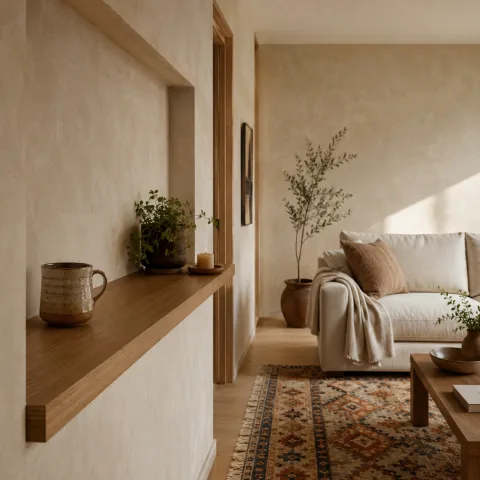
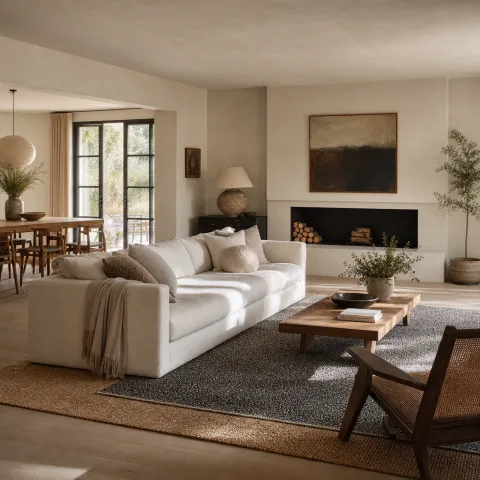
Every flat I have ever rented had one piece of architecture that refused to make sense. Ours was an alcove next to the chimney breast — sixty centimetres deep, a hundred and ten wide, two metres tall, and useless. Bookcases looked stranded in it; an armchair drowned. After eight months of pretending the alcove was a feature instead of a problem, we filled it with three pine boards and a Sunday's worth of patience. The room rearranged itself around the result.
Why a shallow shelf beats a deep one
The standard impulse with an awkward alcove is to fill it. Floor-to-ceiling shelving, books packed two deep, the lot. We tried this on paper and the room shrank in the rendering. A 16cm shelf does the opposite. The eye reads the back wall, not the objects, and the alcove turns from a hole into a frame. You lose storage. You gain a room that breathes.
 Save
Save
There is also a quieter benefit. A shallow shelf forces curation. You cannot stack twenty books on a 16cm board, so you choose six. The choosing is the design. Whatever lands on the shelf has to earn its place, and that single constraint makes the rest of the room feel deliberate by association.
The boards, the brackets, the paint
Three planks of pine, glued and clamped along the long edge, gave us a shelf 16cm deep and the full alcove width minus 2mm of wiggle. We used 8mm steel pins drilled into the side walls instead of brackets, then sat the shelf on top — no visible hardware, the floating look without the engineering. Two coats of a soft warm white in eggshell finish, one in the morning, one after lunch, and by dinner it was a piece of the wall.
 Save
Save
“Whatever lands on the shelf has to earn its place, and that single constraint makes the rest of the room feel deliberate by association.” — Mira
What lives on it now
Six things, currently. A stack of three large-format art books with their spines turned out, a small earthenware bowl, a pear when there is one, a candle we never light, and a framed black-and-white photo of a stairwell in Porto. The arrangement changes about twice a season. Nothing on the shelf is precious. Everything is replaceable. That is the point.
- Books face out, not in. Spines do the visual work; covers are clutter.
- One organic object — a pear, a quince, a single dried branch. The eye needs something living.
- Nothing taller than two-thirds of the alcove height. Vertical breathing room is the trick.
- Leave one section empty. A shelf with a gap reads as composed; a packed shelf reads as storage.
How to do it
Measure the alcove four times.
Old plaster walls are never square. Measure top, middle, bottom, and diagonally. Cut the boards to the smallest reading minus 2mm. The gap will hide behind paint.

Glue, clamp, sand.
Three boards joined along the long edge make a more interesting top surface than a single wide plank — the seam catches light. Glue, clamp overnight, sand at 120 then 220 the next morning.
Drill the pins flat.
8mm steel pins, drilled level with a spirit level resting on the bit. Two per side, plus one in the centre back if the alcove is wider than a metre. The shelf sits on top — no screws visible.
Paint the shelf and the wall the same colour.
Different colours read as a shelf in a room. The same colour reads as architecture. Eggshell, two coats, dry between.
Frequently asked
Can I do this in a rental?
What if my alcove walls are not perfectly vertical?
Why pine and not oak?
How much weight will it hold?
In closing
The room did not need more furniture. It needed sixteen centimetres of pine and somewhere for the eye to rest. Months later the alcove still does most of the heavy lifting in the room — quietly, without making a thing of it. The best decisions are the ones nobody comments on, and this is one of them.