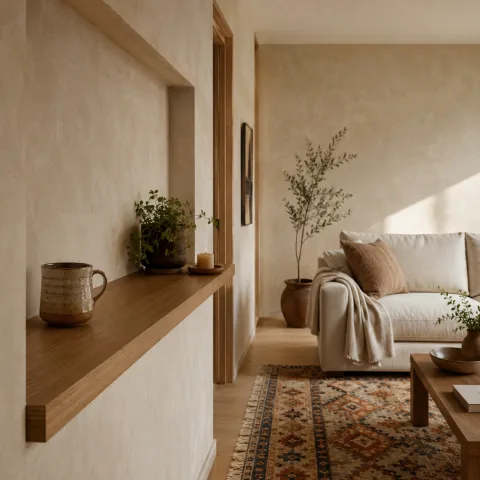
The ritual begins with the blanket. At nine, the room passes from daytime negligence into a quieter geometry: a fold, a click of the kettle’s handle, the soft heartbreak of a lamp being turned off. It is not about polishing surfaces or making everything invisible; it is about three small, repeatable acts that give a boundary to the day. We are renters in a modest Lisbon flat — no built-in cabinets, no lofty living area, just a 14-square-meter room that has to be both workshop, sofa, and a place to sleep when company stays. The acts are humble and cheap: a wool blanket that costs less than dinner out, a kettle we picked up used, a lamp that dimmers would call 'ambiguous'. After six months the ritual felt like furniture in its own right.
The first evening we chose to close
It started on a Tuesday when there was nothing dramatic to tidy and everything stubbornly untidy anyway: a mug on the side table, a scarf slung over the arm of the sofa, a small pile of paper receipts. I folded the blanket because it was getting in the way of my knees when I read. Theo carried the kettle off the burner because the gas rung of the pilot left our hands anxious. Mira — yes, I am Mira — turned down the lamp on the bookshelf because the glare made the room feel like a stage. None of these acts fixed the receipts or the scarf, but the room sighed into a different shape. The difference felt immediate: the room’s edges softened as if someone had closed a book on the day.
The phrase 'closing' arrived as a protest against 'tidying', which is often language for erasure. Tidying can be frantic, aspirational, and expensive: baskets bought in the morning, baskets abandoned by evening. Closing, by contrast, is finite. It marks an end rather than promising a future perfection. On that Tuesday we did three small things and sat. The receipts remained; the scarf was still on the chair. But the room had a balance to it, a quiet symmetry that allowed us to stop fidgeting and have tea on the couch without apologising for the house.
A modest rebellion against perpetual tidiness
Perpetual tidiness often asks us to forget that a room will be used. Closing tolerates life. It allows a mug to exist, a dog-eared book to sit on the table, a knitting project to remain in mid-row. Instead of asking where everything must live forever, closing asks: what would make tonight easier? That question tends to privilege small, reversible gestures. We learned to be conservative: fold the blanket, not stow it; drain the kettle, not clean it; dim a lamp, not remove it. Those small choices respect time and friction.
What actually changed after a week
After a week the closing ritual felt less like a chore and more like furniture. We stopped announcing ourselves to the room with apologetic motions. The ritual also revealed which objects were truly useful in the evening: the blanket survived, the kettle earned its place, the single lamp became our anchor. Friends started timing visits around the ritual, arriving to join us in the last ten minutes before we closed. That small social rhythm — a twenty-minute corridor between active and restful — becomes part of how a home holds people.
Closing versus cleaning: a practical distinction
Cleaning promises a blank slate: surfaces wiped, clutter rearranged, visible signs of life minimized. Closing promises something else: the end of activity and a clear start for the next day. The difference is not semantic. Cleaning is often future-facing and indefinite; closing is ritualized and complete. A closed room is not necessarily cleaner, but it is legible. The legibility matters because it reduces the number of decisions the next morning. You wake to fewer small frictions because someone — you, usually — chose a boundary the night before.
We are suspicious of one-off deep-cleans because they create cycles of intensity followed by neglect. Closing sits between: it is gentle enough to survive weekly and deliberate enough to change how the room behaves. Consider the kettle: cleaning means scrubbing its exterior; closing means emptying it so water doesn't sit and smells don't set. Both have merit, but only one imposes a small daily contract with the space. That contract, repeated, yields a room that feels maintained without performance.
Practically, closing reduces the 'what do I do next' question to a checklist of three or four items. This economy is important in a small, rented flat where storage is thin and life is variable. A small ritual respects limits. The ritual also tolerates mess: a plate can wait in the sink until morning; a needlework piece can keep its stitch for another night. The key is intentionality. We do less, but we do it with purpose.
 Save
Save
The blanket: why wool, why fold, why keep it visible
We bought our blanket at a flea market near Alfama for thirty euros, thicker than a throw, alive with small pulls and a fragrance of other people's evenings. Wool was not a style choice so much as a practical one: it breathes, it warms even when damp, and it gains character with a few honest snags. Keeping it visible — folded over an armchair rather than stored away — turned it into decoration and utility in equal measure. It sits ready for a guest and refuses to be ornamental; its presence signals that the room intends to be used.
Folding is important. A sloppy heap looks like abandonment; an overly precise roll looks like staging. We fold ours in half and then in thirds, aligning the fringes, creating a visible edge that reads as care. This takes thirty seconds. The fold's geometry matters for how the room reads: a folded blanket suggests an intentional pause, a place kept ready. It also protects the fabric from dust and accidental spills without needing a cupboard. In a small rental, the fold is a practical compromise between use and preservation.
Mending as maintenance, not perfection
Small repairs became part of the ritual. A missing fringe prompted a six-minute darn; a moth hole required a patch from a thrifted scrap. Mending is not about making things look new. It is about prolonging usefulness and celebrating the object's life. In a culture that prizes replacement, the act of repairing a blanket quietly contests planned obsolescence. We keep a small tin of blunt needles and wool scraps in the living room so fixing happens where use happens, not in some abstract workshop we'll never reach.
Why visibility matters in a small space
In a small flat, the things you use often must be visible. Out of sight becomes out of use. The blanket's presence performs a dual role: it warms cold knees and signals hospitality. Silence about utility is a luxury; visibility is a cheap, practical design choice. Leaving it folded on the chair avoids one more small task in the morning — unwrapping, finding, arranging — and makes the room feel lived in without being disorderly. For renters, this strategy is especially helpful: it yields a layered look without permanent changes to walls or floors.
The kettle: small rituals for an unromantic object
We learned to treat the kettle like a pet that prefers to be empty at night. A metal kettle left with water overnight is more likely to collect bitterness, liming, and a faint sense of must. Emptying the kettle after use is not a heroic act; it is a small maintenance habit that prevents future fuss. The action is brief — tip into the sink, a quick flick of the wrist, the satisfying emptiness when you lift it back onto the stove — but it punctuates the day. It is also an easy tactile task at the end of evening activity, one that helps us both slow down and finish.
When we started closing regularly the kettle's quiet maintenance changed its role. It stopped being an incidental object and became a deliberate part of the room’s life-cycle. We keep a small wooden trivet by the stove and a simple microfibre cloth in a shallow dish near the sink. Before we learned to close, the kettle’s wetness meant a drip tray and occasional scraping; now it sits dry, less prone to scale, and ready for tea the next morning. The practical savings — fewer descaling scrubs, less mineral build-up — are small, but they compound.
A note on safety and habit
Draining the kettle is partly a safety act. A dry kettle on a gas ring reduces gentle anxieties about damp heat and musty smells in the cupboards. Habituation helps: after a week the action becomes automatic, like closing a window at dusk. In a rental, these small safety acts also show respect for the space and for neighbours; they keep edges tidy and prevent smells or accidental rust. Teaching the habit to guests is awkwardly intimate, so we usually show rather than tell: reach for it, drain it, place it on the trivet.
 Save
Save
When emptying becomes caring
There is a small aesthetic pleasure in seeing familiar objects cared for. The empty kettle looks poised rather than abandoned. Caring does not mean fussing; it means the kettle is predictable. Predictability reduces friction: making tea in the morning becomes a short, known sequence. That economy of motion is underrated. The ritual of draining also slows you: a tiny moment to breathe before heading to the couch, a pause that separates the work of the day from the softer hours that follow.
Light: why one lamp stays on and the rest go
A single lamp left on makes a room feel intentional rather than abandoned. When all lights go off the space becomes anonymous; a lone lamp leaves a corner to be looked at rather than erased. We learned to leave one low, warm lamp on — usually the bookshelf lamp — and turn off ceiling lights. The lamp creates layers: a readable pool for a book and a soft shadow across the rest of the room. The effect is confessional; it invites us to sit and finish rather than to begin another task.
Leaving one lamp on also helps with transitions. If someone rises at night they won’t be confronted by darkness; the lamp eases motion. The lamp choice matters: a cool LED looks clinical; a warm incandescent or warm-LED bulb suggests softness. We keep a 2700K bulb in the lamp and a small dimmer that allows the light to drop but not extinguish. The habit is small and reversible yet changes the room’s emotional contour more than rearranging cushions would.
Layering light for different moods
Layered lighting — a reading lamp, a kitchen pendant, maybe a candle — lets you sculpt the room. The closing ritual asks for subtraction: reduce overhead, keep a task light. That small subtraction is economical: it uses less electricity, creates more intimacy, and signals the end of activity. We arrange our plugs so the lamp that stays on is the easiest to reach; convenience reinforces habit. Over time the lamp becomes a marker: when the lamp is on in the corner, the room is almost closed.
Decisions that prevent fuss in the dark
We also make small physical decisions to reduce friction at night: a low table free of sharp corners near the lamp, a clear path between couch and kettle, and a coaster by the armchair for a mug. These are not decorative choices so much as anticipatory ones. When the lamp is on and the path is clear, reaching for a book or a cup is easier, which makes the ritual inviting rather than a list of chores. In short: choose one lamp that you like, make its corner comfortable, and leave it as a courtesy to the night.
 Save
Save
The choreography: order, timing and a few rules
The ritual matters because of its order. We fold the blanket first, empty the kettle second, and dim the lamp third. The sequence is deliberate: the blanket is tactile and often in the way; the kettle is a safety and maintenance gesture; the lamp is the last breath. We set the time — nine p.m. most nights — and treat it like a soft bell rather than an alarm. Making the ritual a predictable cadence means it survives tiredness and busy evenings; rituals thrive on repetition, not on perfection.
There are a few rules we follow. Keep the actions brief; they should never feel like chores. Keep the objects in the room so the gesture is easy. If a guest is present, offer them the blanketed armchair before folding it away — ritual should not exclude. Allow flexibility: sometimes the ritual is deferred for late arrivals, sometimes it is compressed. The aim is resilience: the ritual should be able to bend without breaking. That resilience is the point; a brittle routine is a failing one.
Timing that respects the day
We pick a time that makes sense for our rhythms. For some households it might be later; for others earlier. The important thing is that it is mutual and consistent. The chosen time becomes social infrastructure: partners know when to wrap up, guests know when to leave, the household learns to steward its energy. A shared hour gives both permission to stop and a social cue that the day is winding down. Rituals that impose without consent fail; our version evolved because it was gentle and negotiable.
Small rules that become habits
The rules are intentionally minimal: three gestures, each under thirty seconds; do them in sequence; let the rest be. It's a small program that teaches itself through practice. We found that naming the ritual — calling it 'closing' instead of 'tidying' — helped. Language matters because it frames the action. Once it has a name, it can be invited, declined, passed to someone else, or adapted. We also keep the tools for the ritual visible: a kettle cloth, a trivet, and a little basket for the blanket’s loose threads.
 Save
Save
Objects that help: baskets, hooks and a small basket for mending
The ritual is easier when the right objects are in the right place. A shallow basket beside the armchair holds a pair of reading glasses, a bookmark, and a small notebook. A hook near the door holds a frequently used scarf, and a low tray by the kettle keeps the trivet and cloth together. These objects are not decoration in the celebrity sense; they are practical companions. In a small flat, the right container is one that is easy to reach and simple to maintain. Choose inexpensive, honest materials: woven seagrass, unvarnished wood, a tin that can be dented without drama.
The small basket for mending
We keep a tiny basket specifically for mending: a spare button, a length of yarn, a needle, and a little instruction scribble for visitors who want to help. Having these items in the room means mending happens where the object is used. It prevents the moral busywork of 'I should repair that' from stretching indefinitely. Mending in the living room is social and visible; someone can ask to help, share a stitch, or offer wine while you work. The basket makes repair domestic and undramatic.
Hooks and a place for small things
Hooks are inexpensive and reversible for renters. A single hook behind a door or near the entrance collects that night's coat or a bag, preventing a pile on the chair. A shallow dish by the door holds keys and loose change. These small decisions — cheap hooks, a secondhand tray — reduce visual clutter without a catalogue of storage solutions. The aesthetic payoff is in the room's calmness rather than in homogenous matching containers. Function first; the look will follow when habits are in place.
- A shallow basket beside the armchair for small mending tools
- A wooden trivet and tea towel kept by the kettle
- A single hook near the door for scarves and bags
Why ritual changes how a room holds memory
Ritual is a social technology for memory. Folding the blanket becomes a way to mark time: here is the place where you read, here is where you rest. Small rituals create a mental map of the room’s uses. They make patterns predictable and allow memory to find its anchors. The next morning you recognise the folded blanket before you process anything else; it tells a story. These tiny refrains accumulate into a longer narrative of home: the objects become characters, the rites become punctuation, and the room assembles a continuity that matters more than immaculate surfaces ever could.
Rituals also change how we forgive the room. When a place is closed with care, little lapses feel less like failures and more like stories. A teabag left in the sink is now an accommodation in the story of the evening, not a refutation of competence. The ritual creates a margin for human error. In that margin, life happens: knitting, crying, hurried cooking, the sudden joy of guests. A room with rituals can hold memory without collapsing into disorder or performance.
“Closing is a punctuation mark for a day well-lived, not an erasure of it.” — Mira
There is a humane politics to this too. In households with multiple people, ritual distributes responsibility in a gentle way. It creates low-friction tasks that are easy to do. It also makes the room legible to visitors: they can orient themselves quickly and contribute if they want. Rituals allow domestic labour to be mundane and shared rather than hidden and heroic. This modest redistribution matters, especially in small rentals where each object’s care disproportionately affects the whole.
How to do it
Fold the blanket
Fold the wool blanket in half and then in thirds, align edges and place it over the armchair or a low shelf so it’s accessible for the morning.
Empty the kettle
Carefully tip any remaining water into the sink, give the inside a quick swill if needed, and set the kettle back on its trivet to cool.
Dim or turn off lights
Turn off overhead lights and leave a single warm lamp on low to mark the room as closed and gently lit.
Frequently asked
Do I need special objects to start closing each night?
What if I don’t want to fold the blanket every night?
Will draining the kettle damage it?
How do I invite housemates into the ritual without sounding bossy?
In closing
There is one image I return to: the blanket folded along its centre, the kettle empty and tucked back on its mat, a single lamp left to keep a corner warm. That image is a room’s punctuation — a full stop rather than an erasure. Closing is neither cleanliness nor performance; it is a permission to stop tending for the night and the courtesy of a softer morning. The rule we keep is simple: do three small things, and let the rest be. In an age of 'before-and-after' triumphalism, that seems radical. The ritual does not hide the life lived in the room; it honours it and frames it, making the ordinary objects around us feel like companions instead of clutter.