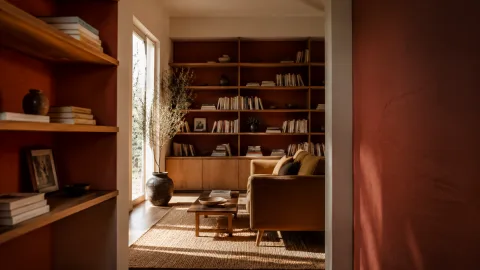
Our living room was organised around a red-brick chimney breast that nobody had asked for. It was the first thing you saw, a hard orange-red rectangle that argued with the soft palette of everything else, and boxing it in or painting it flat with emulsion both felt wrong. Limewash was the answer: a chalky, breathable, mineral wash that bonds with the brick itself, softening the colour to a cloudy off-white while keeping the texture of the brick alive beneath it. A weekend and three thin coats later, the chimney went from the room's loudest voice to its quietest.
Why limewash, not emulsion
Emulsion sits on top of brick as a plastic skin: it looks flat and dead, it traps moisture in an old chimney that needs to breathe, and it eventually peels. Limewash does the opposite. It is calcium hydroxide that reacts with carbon dioxide in the air and bonds chemically into the masonry, becoming part of the brick rather than a coating on it. It lets the wall breathe, it never peels, and it weathers by softening rather than flaking.
Visually, limewash keeps the brick's texture and mortar lines faintly readable under a cloudy veil, where emulsion would bury them under a uniform coat. That ghost of the brick beneath is exactly the soft, lived-in look we were after — present, textured, but no longer shouting.
 Save
Save
Three thin coats, brushed wet
The first coat is alarming: thin, streaky, translucent, and you will be sure it has failed. It has not — limewash builds. The second coat starts to read as a cloud; the third settles into the soft, even-but-not-flat chalk finish that is the signature of the material. Each coat goes on thin with a natural-bristle brush in random overlapping arcs, never straight stripes, because the gentle cloudiness comes from the brushwork itself.
Patience between coats is the whole discipline. Each needs to dry and begin to carbonate before the next, which on brick means a few hours in a warm room. Rushing a thick coat to skip the wait gives you drips and a dead flat patch instead of the living, cloudy depth that three thin coats build.
 Save
Save
“It became part of the brick rather than a coating on it.” — Theo
Living with a limewashed wall
A limewashed chimney is matte in a way no paint achieves — it absorbs light and changes through the day, warm and creamy in morning sun, almost grey at dusk. It is chalky to the touch and will mark slightly if rubbed hard, which reads as patina rather than damage. Near a working fire, limewash is the historically correct finish precisely because it breathes and tolerates heat where emulsion blisters.
Maintenance is essentially none. It does not peel, so there is nothing to scrape and repaint; in years to come a worn patch simply takes another thin coat blended in, with no stripping first. The wall ages by softening, which is the opposite of every painted surface we have ever had to redo.
- Limewash bonds into bare brick and breathes — no primer, no peel.
- Mist the brick damp before every coat to stop a powdery finish.
- Three thin coats build cloudy depth; the first looks alarming, trust it.
- Brush random arcs with natural bristle; the cloudiness is the brushwork.
How to do it
Clean the brick.
Brush off dust and loose mortar, wash and let dry. Limewash will not bond to grease, soot or flaking surfaces, so a sound clean wall is the start.
Mist with clean water.
A garden sprayer, even passes, until the brick is damp but not running. Wait a few minutes for it to absorb before the first coat.
Three thin coats.
Natural-bristle brush, random arcs, thin. Let each coat dry and begin to carbonate before the next. Re-mist between coats.
Leave it to cure.
Limewash keeps hardening for days as it carbonates. Avoid rubbing the fresh surface for a week; the chalkiness settles and toughens with time.
Common mistakes to avoid
Using fake limewash
Much of what is sold as 'limewash' is emulsion with chalk stirred in — it sits on the surface, traps moisture and peels like any paint. Buy genuine calcium-hydroxide limewash from a heritage or eco supplier for the real breathable, bonding finish.
Skipping the mist
Brushing limewash onto dry brick lets the masonry drink the water straight out of it, leaving a powdery layer that wipes off on your hand. Mist the brick damp before every coat and the lime bonds hard instead.
Panicking after coat one
The first coat is thin, streaky and translucent, and every first-timer assumes it has failed. It has not — limewash builds over three coats. Stop, let it dry, and trust the second and third to deliver the cloudy depth.
Frequently asked
Can I limewash painted brick?
Is it safe near a working fire?
Will it rub off on clothes?
Can I add colour?
How long does it last?
Do I need to seal it?
What protection do I need?
In closing
The chimney breast is still brick, still textured, still the focal point of the room — but it no longer shouts. Three thin coats of limewash softened it to a cloudy chalk-white that changes with the light and breathes with the wall. A weekend's patience turned the room's loudest feature into its calmest.