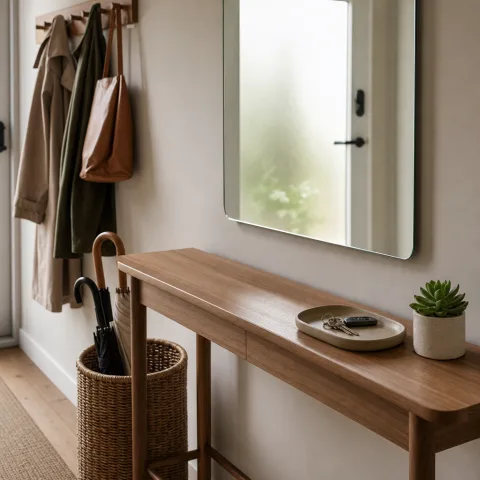
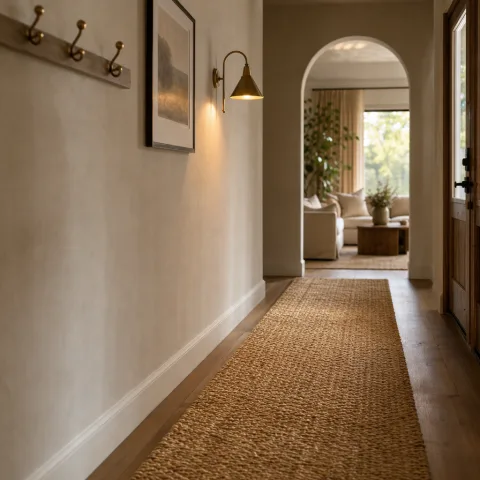
It began as a small, stubborn itch: every time the front door closed it would knock the sleeve of a coat hanging off the shoe rack and land the brass buckle against the wall. I carried the coat to the closet three times a day and cursed the shape of the hall, the shoulder of the coat, and my own laziness. By Saturday I had a stud finder, a tube of working coffee, and a cheap brass hook in my pocket. The thing about small fixes is they shift how a room moves — not by grand design, but by a millimetre of geometry. The hook didn't announce itself; it simply arrived, threaded into timber in thirty seconds, and the door stopped catching fabric. That particular, slightly ridiculous victory is what I want to write about: how one simple fastener teaches more about living well in a tiny rental than any Pinterestboard.
A small Saturday and a brass hook
The morning started unheroically: coffee in a chipped mug, the old stud finder pressed against a white wall where years of picture hooks had left pale halos. I had bought the brass hook on a whim the day before, more because it looked like it had a good shape than because I thought I needed it. The hall is narrow — roughly the width of two shoulder blades — and the door swings in a long lazy arc that intersects with coats left on a shallow ledge. The first time I drilled, I used the wrong bit; the screw threaded in crooked and the hook wobbled as if in apology. The right bit — a short, sharp masonry-style bit that matched the tiny pilot hole the hook required — made everything settle. It took thirty seconds and a quiet, ridiculous sense of relief followed. The room breathed differently.
There is a particular pleasure in fixes that cost almost nothing: the brass hook was four euro, the drill bits a few euros more, and the stud finder a small thrift-store victory. The value wasn't in the purchase but in the thought that preceded it — measuring, imagining, and moving slowly enough to notice how a coat travels from shoulder to peg to floor. Our hall has the kind of personality that radiators and doorframes give off: practical and a little impatient. A hook that catches a coat at the exact moment before the door would thud it is more choreography than furniture. It rearranged a daily movement and thereby made the space feel less accident-prone.
I like to think of this as applied kindness: small, deliberate adjustments that make ordinary motions kinder to objects and to bodies. There is also a streak of contrariness — we live in a culture that hoards big furniture and ignores the tiny fittings that actually mediate a life. The brass hook is anonymous and dignified in equal measure; it doesn't shout brand or trend. It asks only to be put in the right place, and then to be left alone. The rest of the Saturday felt like that: checking the alignment, swapping bits, laughing at the absurdity of bringing instruments to a domestic drama that would have solved itself given time. But fixing it meant no more damp cuffs and no more half-excuses for knocked-over shoes.
The stud finder revelation
There is a tiny, reverent moment when the stud finder gives a soft beep and a homeowner understands that timber still exists behind plaster. Ours is an older rental with a lumpy wall history — picture hooks, a couple of half-hearted shelves, and a patch that never quite matched the paint. If you drive a screw into just plaster, you get persuasion and anger: the screw spins and the hook sits loose, sulking. The stud finder pointed to a narrow vertical strip of denser wood behind the wall. Anchoring the hook there changed everything. The hook no longer relied on glue or an anchor; it had structure. This is not carpentry pretension so much as common sense: find the load-bearing little bit and use it.
Why the right bit mattered
I have a box of drill bits that looks like a small, uncurated exhibition: one for metal, one for masonry, a set that has seen better days. The wrong bit chewed the edge of the hole and left the screw hunting for purchase. The right bit made clean, small particles fall away and let the screw thread like a zipper. Choosing the right bit is less glamourous than choosing a good lamp, but the consequences are more permanent. A clean pilot hole preserves wood and paint; a ragged one expands under pressure and invites wobble. For a tiny hook that must hold a daily coat, the correct bit is a cheap insurance policy.
The geometry of a good catch
Geometry sounds grand but in a hall it means two simple things: the hook must sit out of the door's swing and at a point where a shoulder and collar naturally rest. We tried three positions: too close to the door so that the coat brushed the jamb, too high so the coat looked like it was wearing a crown, and too far in where it obstructed the shoe tray. The correct position was modestly inward from the jamb and at a height that caught a coat's shoulder without lifting it. This is not a rule book so much as an invitation to test: mark three points, live with each for a day, and keep the one that makes the least noise.
A useful measurement is to stand in the doorway as if you were just returning and hold the coat where it would drop. Notice where the fabric brushes the wall and where the shoulder sits. Our decision was less a formula than a rehearsal. We found that fifteen centimetres inward from the edge of the doorframe and roughly 160 centimetres above the floor caught our jackets without pulling them away from the body or letting the collar hang on the door. Those numbers are specific to our heights and the thickness of our winter coats; clothes with broader shoulders or kids' outerwear will shift the optimum position slightly inward or upward.
The shape of the hook also plays with geometry. A low, rounded hook keeps a coat's shoulder close to the wall and reduces leverage on the screw; a long, forward-facing hook provides purchase for bags but increases the torque when a heavy item is hung. The small brass crescent we chose leans modestly outward then curves back toward the wall — enough to cradle but not enough to lift. It became apparent that style and physics were working the same way: a pretty shape that matched the motion we needed. Once in place, the coat no longer pushed the door; the door simply moved around the hook like a careful friend.
Angle and clearance
The door's arc is the invisible actor here. Stand where the hinge is and watch the sweeping ellipse of the door edge. You want the hook to be clear of that ellipse but close enough that a coat resting on it does not extend into the arc. A practical trick: tape a strip of butcher paper to the door and swing it; you will see the path the edge sketches. Our butcher-paper experiment showed us that even a centimetre makes a difference when coats have volume. Clearance is not about avoidance entirely; it is about choreography — letting the door and the coat each have their moment without colliding.
How the door moved
Before the hook, the door had a habit of catching fabric and stopping half-closed; after the hook it closed cleanly with a small, polite clack. The difference is as much about rhythm as it is about clearance: the door no longer negotiates a coat's presence but passes around it. This change altered how we entered the flat: there is no more juggling of keys while trying to keep the coat from slipping; one hand can hold the bag, the other can ease the door, and the coat stays where it belongs. It is tempting to call this minor, but small reductions in friction add up to time and attention reclaimed every day.
 Save
Save
Tools worth buying once
I like lists that have the quiet quality of a small library: one reliable tool for each recurring problem. For mounting a hook in a rental, the essentials are not extravagant — a stud finder, a set of three drill bits that cover wood, metal and masonry, a compact cordless drill, and a pack of short brass screws. The stud finder cost ten euros; the drill bits cost a little more; the cordless drill was the priciest item but we had borrowed one from a neighbor. The point is practical: buy the simplest quality that will work. These items live in a small canvas bag in the hall closet now, not because we are becoming tool hoarders but because the next tiny fix will demand them.
There is a psychological difference between borrowing a tool and owning it. Borrowing invites hesitation and scheduling; owning invites small projects that remake the domestic edges of our life. The stud finder changed more than the placement of the hook; it changed our confidence. We began to notice where shelves might be steadier, where a picture could be hung without anchors, and which plaster patches hid real studs. That said, I do not recommend buying every gadget advertised for home improvement — the useful ones are humble, specific, and durable. The hobby is not accumulation; it is targeted competence.
The drill bits deserve a short apology and praise. We tried a long, general-purpose set first and the bits flexed and slipped. The short, stiff bits bit with a neat, economical hole. We learned to test bits on a scrap of plaster or an inconspicuous patch of wall before committing. There is wisdom in minimalism here: a small collection of reliable bits outperforms a large set of questionable quality. You will use the right one twice and the wrong one forever if you keep it. Store them in a small tin and they will be ready when the next absurdly minor but essential job appears.
Cheap versus useful
Cheap tools that fail do two things: they waste time and teach caution. Good tools teach confidence. The stud finder we bought for ten euros is not a luxury but a compass; a reliable little instrument that points to a narrow truth behind the wall. The lesson is to spend a little more on what you will use in decisive, nerve-calming moments. We do not own a full workshop, but we own a handful of items that let us intervene thoughtfully. For renters, this is the best economy: a small investment that keeps your place functional and reversible.
The drill bits we used
For our little hook the useful set included a 3 mm wood bit for a neat pilot hole, a 4 mm masonry bit for stubborn plaster, and a countersink bit for finishing, should we want the screw head to sit flush. The 3 mm pilot hole was the charm; it guided the screw and offered the little friction the brass thread needed. Keep the bits short for control and swap slowly if you feel resistance. If a bit smokes or blunts, stop and consider a different size rather than forcing the issue. Small, considered choices protect the wall and the fastener, and reduce wasted time.
 Save
Save
“Little fixes don't shout; they adjust the way a room breathes.” — Mira
Mounting in a rental: invisibly
Renters often face a trade-off between permanence and permission. I have been guilty of both — leaving a wall pristine at the expense of daily annoyance, or drilling like I owned the place. The compromise is reversible, honest work: use the studs when available because repairs there are simpler, and if you must use anchors, choose ones that leave tidy, small holes that can be filled and painted later. Communicate with your landlord if you're unsure; in our experience, showing a simple plan and promising to restore the wall wins more goodwill than fantasies of stealth. Above all, be careful with wiring and plumbing. They care less for your aesthetics than for your safety.
Locating wires and pipes is less dramatic than it sounds. The stud finder will often have a mode to indicate live wiring; a non-contact voltage tester adds a second layer of reassurance. Our building uses older wiring but in this spot the studs were clear and the pipes ran vertically in the bathroom wall, not through our entry hall. If you do hit a live wire — and I say this with the clarity of someone who has never wanted an electrician on a Saturday at dusk — stop immediately and call a professional. Small jobs are fine until they involve electricity or a water line. Then they become a different class of problem entirely.
Patch-friendly fittings are your ally. Hooks that mount with short screws and minimal countersinking leave small, circular holes that are easy to fill with spackle and sand smooth. Avoid big anchors that leave wide impressions unless you truly need them for heavy loads. If a landlord prefers not to have permanent screws, consider using a brass picture hook that takes a single tiny nail high in the stud — it supports light coats and disappears under paint easily. Our hook used two small screws into timber and, when the day comes, it will be painlessly removed and the marks will be insignificant compared with the benefits it provided.
Finding safe places to drill
Start by scanning the wall vertically and horizontally with the stud finder, then mark potential points with a pencil. Use the building's history to guide you: older walls often have skirting and baseboard cavities where pipes are less likely, while modern renovations sometimes run services horizontally. Keep a tape measure handy, and if you find anything inconsistent — a hollow buzz, a vague signal — err on caution. I like to tap the wall lightly too; a hollow sound shifts to a firmer note where studs live. These combined little tests reduce the odds of surprise and help you place a hole that will be simple to repair later.
Patching and future tenants
When the time comes to leave, a small hole heals quickly. Fillers are forgiving if you sand between coats and match the texture before painting. Keep the bits of paint you peel from the wall in a labeled envelope if possible; they become reference for a touch-up. A small, tidy repair communicates respect for the space and makes the landlord more likely to approve future small interventions. We have returned walls to a better state than we found them on more than one occasion simply by ensuring that every screw left behind came out clean and every hole was filled like a careful editorial correction.
 Save
Save
Design, brass, and small pleasures
Choosing brass was partly aesthetics and partly practicality. Brass tolerates the oils of hands and develops a soft patina that looks like memory rather than neglect. Its warm tone read well against our pale wall and the oak floor; it didn't compete with other finishes in the hall and, over time, it will narrate the small gestures of use. A brass hook also resists rust better than cheaper steel options — important for shovels, umbrellas, or damp scarves. The form of the hook should be deliberate: nothing too ornate, nothing too industrial. In a small space, modesty of scale is its own decoration.
The patina that brass earns is not a flaw; it is evidence of use. We have watched the hook darken where fingers habitually touch and brighten where the coat brushes it. These small contrasts make the object feel like it belongs. If you prefer a polished look, a light wax buff will restore shine without sanding away the lived-in quality. For rentals, that balance matters: choose finishes that age with you rather than demanding perpetual maintenance. A small, well-made brass hook will look better with a year of coats behind it than a brand-new shining one that reveals every fingerprint.
Placement in a small hall is also a design decision. Hooks function like punctuation: a single hook can signal a pause, a pair can set rhythm, and a row can create a chorus. We chose a single hook not out of frugality but because our circulation pattern only needed one. Too many hooks in a tight space invites clutter; one well-placed object encourages restraint. The eye rests on that small brass point and the rest of the hall arranges itself around it. The aesthetic is less about matching materials and more about proportion and restraint — what I like to call architecture of the minor.
Why brass?
Brass is generous in finish: it doesn't demand cleaning to look intentional, and it pairs easily with wood and woven textures. It also performs well mechanically: it resists corrosion and threads accept screws cleanly. For a small hook that will take daily abuse, brass feels like the rational choice. There are plenty of alternatives — stainless steel for a cooler palette, painted steel for a pop of colour — but for a hall that is soft in tone and modest in scale, brass reads as steady and kind. Choose it when you want an object that will quietly improve with handling.
Placement as composition
Think of the hook as an accent in a paragraph of space: it should come where the sentence needs a comma, not where it demands a period. In practice that means aligning the hook with visual lines — the top of a skirting board, the grain of a nearby plank, or the midpoint of a picture frame on the adjacent wall. Small alignments create a sense of intention without requiring matching sets or expensive pieces. The hall then reads as curated rather than accidental; that quality is what makes a rental feel considered rather than contingent.
- Brass hook, 2–3 cm projection
- Short brass screws (brown or matching finish)
- Stud finder or small magnet for locating nails
- 3 mm pilot drill bit and a countersink
- Small tin for spare screws and touch-up paint swatch
How I measured and fixed it in thirty seconds
The thirty-second part is slightly theatrical: the long Saturday consisted of five minutes of measurement, twenty minutes of testing positions, and then a quick decisive action. The actual act of drilling and screwing the hook in took less than a minute once the pilot hole was right. Preparation is the slow work; execution can be quick. I measured from the doorframe, taped a pencil mark, checked the stud finder, drilled a measured pilot hole, and then eased the screw until the hook sat tight. The moment the hook aligned was ordinary and electric: the door closed, the coat rested, and something about the flat felt more settled.
Measure from fixed points: the floor where scuffs are regular, the doorframe where paint holds true, or the midpoint of a visible moulding. I prefer a two-point approach: one horizontal measurement from the doorframe and one vertical measurement from the skirting. This gives a reproducible coordinate and reduces guesswork when holding the hook. Mark both points lightly with pencil and then confirm by holding the coat in place. If the mark pleases both the eye and the elbow, it is the right one. This method avoids the superstition of 'eyeballing' and keeps the intervention tidy and reversible.
Quick measuring rules
A few rules of thumb that have saved me time: measure from the doorframe rather than from the centre of the hall, use a visible fixed line like the top of skirting as your vertical reference, and always mark two points to keep the hook level. If you share a home, ask your partner to test the height by standing and pretending to hang up a coat — bodies reveal details a measuring tape misses. Finally, test with the coat you actually use most often. A hook that suits a weekend jacket may misbehave with a heavy winter parka. These small rituals remove guesswork and make the execution smooth.
The single drill motion
When the pilot hole is correct, the drilling motion should be steady and brief. Hold the drill perpendicular to the wall, use a low speed to start and increase slightly if necessary, and withdraw occasionally to clear dust if the wall is dense. Insert the screw slowly, using the bit as a guide, and stop when the hook sits flush without forcing. Avoid over-torquing; it crushes plaster and strips threads. The right touch is gentle and slightly impatient — the hole is the invitation and the screw accepts it. Thirty seconds is possible when the preparatory work is done well.
 Save
Save
- Locate a stud or safe mounting point with a stud finder
- Mark two reference points from stable features (doorframe, skirting)
- Drill a 3 mm pilot hole perpendicular to the wall
- Insert the screw and mount the hook, checking clearance with the door and coat
How to do it
Locate a stud or safe point
Scan the wall with a stud finder and tap to confirm a firm substrate; mark the point lightly with pencil.
Measure from fixed references
Measure horizontally from the doorframe and vertically from the skirting board to get a reproducible position; mark two points to keep the hook level.
Drill a pilot hole
Using a short 3 mm bit, drill perpendicular to the wall at low speed; withdraw occasionally to clear dust.
Attach the hook
Screw in the brass screw until the hook sits flush; check clearance with the door and hang a coat to test.
Frequently asked
Will a small hook hold a heavy winter coat or a bag?
Can I drill without permission in a rental?
What if I hit a wire or pipe?
How do I make the hook look good over time?
In closing
We live with small compromises: a narrow hall, a coat that forgets where it belongs, a landlord who prefers neutral paint. What our four-euro hook gave back was not beauty so much as permission — permission to notice the space's movement and to make one small, reversible change that improved it. There is a rule worth keeping: decide on one precise point where something should sit, find the structure behind it, and use the smallest durable fix you can. The rest is theatre. In the months since, the hook has darkened a fraction and collected a polish from our fingers. The door closes cleanly now, and closing it feels like closing a small, private sentence. Little interventions like this are not about accumulation; they're about listening closely enough to your home to answer with a modest, well-chosen object.