The hallway in our Lisbon flat is 1.6 metres of compromise: the width of the skeleton between front door and daily life. It used to be the place where things went to become anonymous — umbrellas, a year’s worth of receipts, one unread magazine, a shoe that never seemed to find its mate. The first winter we lived here I learned the physics of a small corridor: clutter produces velocity. You bump something, it topples, you kick it, later you complain. We decided to treat the strip like a tiny room: one function, one piece of furniture, one rule. The cabinet is no bigger than a bedside table, the hooks are simple brass discs, and the rule is graceless in its clarity — nothing on the floor. That rule is the point: it demands a home for each small object and asks for daily care, not heroic cleaning sessions. Six months in, it has changed how we enter the flat, how we leave it, and oddly, how we travel.
The one rule that changed everything
The rule was deliberately boring: nothing on the floor. No shoes left to fester at the door, no open tote bags, no seasonal cast-offs sleeping where we tripped. It sounds punitive, and for a week it felt fussy. But it also has the flavor of a domestic pact — an agreement that you keep because it rewards you immediately. When you step inside and there is no pile under your keys, you notice it. That small absence shifts the tone for the rest of the home; the hallway acts as a threshold cleaned of its own dramas. The rule required one practical thing: a place to put everything else.
Rules in a small home must be narrow to survive. We tried a variant: 'no more than three things on the cabinet.' That failed after two nights because it encouraged a game of relocation — what to remove tonight to make space tomorrow. 'Nothing on the floor' is simpler and prophylactic: it channels all the negotiating into a single question — where does this belong? That question, answered daily, builds a habit. It is less a prohibition than a prompt to place. The prompt made us consider storage as behavior change rather than decoration.
Why a small rule beats a large system
Large systems — labels, baskets for every category, color-coded docks — collapse in a small home under their own weight. They require time, materials, and a kind of enthusiasm that fades. A single rule requires only memory and small muscle. It sidesteps the aspiration to 'get it perfect' and replaces it with a single repeated act: pick up. That was crucial in a rental where we could not install built-in lockers or borrow square footage from another room. The rule accommodated the limitation and turned constraint into a reliable behavior.
The social contract of a doorway
A rule only works when the people who use the space agree to it. Saying 'nothing on the floor' aloud made it feel less like a private preference and more like a small household covenant. Friends visiting began to follow it unbidden, placing their shoes in the cabinet or leaving bags on the small bench we borrowed for the first week. Turning a habit into a shared cultural practice simplified enforcement — no nagging, just the gentle shame of searching for shoes and finding a place already reserved. The rule thus became a language for guests too.
Measuring a hallway: 1.6 metres is plenty
The arithmetic is domestic and humility-inducing. 1.6 metres is not generous. It is narrower than a couch, shallower than most storage cabinets, and barely wide enough to allow two people to pass with good will. That measurement dictated every choice: depth of the cabinet, the hook profile, the height of the wall shelf. Measuring honestly — not rounding up because you want a prettier piece — saved us from a furniture-sized regret. The cabinet's depth had to be less than 30 centimetres; the top had to carry a tray and a plant without crowding the walkway.
Scale over style became our mantra. There were plenty of attractive cabinets that would have looked charming and then turned the hallway into an obstacle course. We measured the swing of our door, the clearance of the radiator, and the footprint of our weekly grocery bags. We positioned the cabinet so one person could open the door and step inside without asking someone to move. Practical decisions like these seem dull but they are the architecture of calm: small choices that prevent future irritation.
Depth, clearance and the door swing
We taped the floor to mock-up three depths: 25cm, 30cm and 40cm. At 40cm the aisle felt congested; 30cm was the borderline; 25cm felt slim but useful. We went with 28cm in the end — a compromise that allowed a row of flats in front and a slim internal shelf. Clearance for the front door's swing required a 12cm buffer so the cabinet wouldn't be hit when the door opened all the way on its hinges. If you live in a small place, mock-ups with tape and a moving box are the cheapest furniture store you will ever visit.
Make decisions you can live with
When a purchase is limited by measurement, the conversation becomes about tolerance: how much of an inconvenience can you accept for the sake of a look? Our answer favored tolerance for visual modesty and intolerance for functional compromise. That meant choosing a simple cabinet with a thin top rail rather than a piece with decorative overhang. A small decision like this keeps the hallway physically navigable and visually quiet; it also prevents the small irritations that grow into larger habits — like leaving shoes in the doorway because the cabinet door is awkward to open.
 Save
Save
Choosing a slim cabinet that actually stores things
We had three requirements: shallow depth, a door that opens without intruding, and internal shelves adjustable enough to hold a tall umbrella and a stack of flats. Most narrow cabinets you find online are decorative; they sacrifice interior volume for a profile. We wanted volume that hid the mundane — the shoe collection that is insufficiently matched, the mass of reusable bags, the umbrella we never remember until it rains. We chose a simple ply cabinet with two internal shelves, a soft-close hinge, and a lip to keep items from sliding out when the door opened. It cost less than a designer console and has aged better than the wall paint.
If you are in a rental, portability matters. The cabinet is light enough to be carried by two people and narrow enough to wedge onto the stair landing when we repainted the hallway. We avoided built-in solutions for the aesthetic of reversibility; we wanted a piece that looks intentional but does not require tenants' permission to install. A cabinet on legs also keeps the visual plane airy. Legs create a small shadow underneath, which gives the impression of more space, and make cleaning less of a penance because you can sweep or mop under without moving heavy furniture.
Materials and finish for a rental
We settled on birch plywood with a simple whitewash because it reads neutral against our limewashed walls but hides knocks better than high-gloss paint. Plywood also takes light paint and repairs easily; a small gouge sanded and rubbed with a matching stain disappears in minutes. For rental life, avoid fragile veneers and ornate moldings that look great in a listing but fail under daily use. If you rent, choose finishes you can live with and touch up when necessary — part of responsible tenancy is leaving the place in a state that another tenant won't curse you for.
Shelving decisions inside a tiny cabinet
Adjustable shelves let the cabinet be a chameleon: an umbrella one month, a basket of scarves the next. We created a bottom shelf with a slightly higher lip for shoes so they would sit steady and be easy to pull out. A simple pegboard insert at the back gives the option to hang a slim flashlight or a key hook without drilling into the wall. Think about what will live inside before you buy; the right internal organization reduces the temptation to leave things on the floor because there's nowhere to hide them neatly.
 Save
Save
Four hooks: spacing, height and tiny politics
Hooks are democratic furniture: cheap, public, and intensely negotiated. We chose four because it balanced couple life with the occasional guest. Too many looked cluttered; too few meant coats ended up on the banister. Spacing matters — 20 to 25 centimetres horizontally gives room for bulky winter coats; 15cm is fine for scarves and lighter items. The vertical placement should consider bag straps, coat lengths, and a small child if you have one. We mounted ours at a height that lets a coat hang without touching the cabinet top and a bag hang without dragging on the floor.
The political part is the etiquette: a hook is a communal resource. When guests arrive, they often assume the rightmost hook is theirs; partners silently contest the closest one to the door. We solved this by rotating positions in the first week and by casually suggesting that each person use two hooks: one for coat, one for bag. Naming space removes friction. It sounds silly, but in a corridor barely wider than a person, who hangs where matters and small agreements prevent daily skirmishes. Design is often the scaffolding for manners.
Hook shape and finishing touches
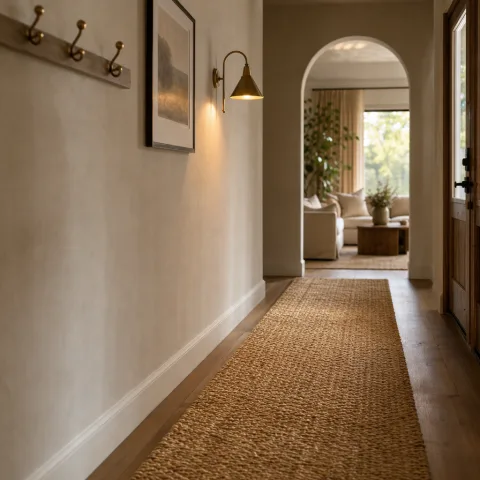
We picked simple disc hooks with a short curved nose because they don't let straps slide off and they sit flush when empty. Avoid skinny hooks with sharp tips that catch knitwear. A small rubber bumper behind each hook protects the paint. Finish matters too: matte brass is forgiving, hides fingerprints, and picks up the warm tones of wood. If you love minimal looks, resist the tiny aesthetic trap of hidden hooks; visible, honest hardware tends to age more gracefully in a lived-in corridor.
Mounting without drama
We used wall anchors appropriate for plaster and a small spirit level; the kind you can borrow from a neighbor if you're shy about buying tools. Drill once, measure twice. We spaced hooks symmetrically over the cabinet and found that a centering line drawn with pencil saved arguments. In a rental, use screws that allow for tidy patching — choose anchors that leave small holes and keep the wall dust for touch-ups at move-out. A careful mount avoids the lingering irritation of a hook that leans or loosens after a month.
 Save
Save
What lives on top: containers that perform
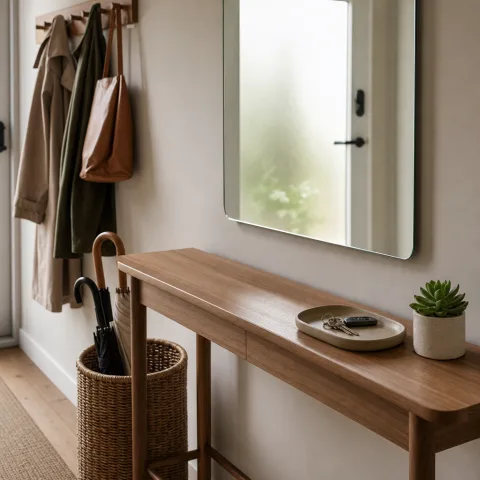
The top of the cabinet is where the drama of transit happens: the swap of keys, the dropping of mail, the attempt to outwit a rainy day. It needs containers that are obvious, attractive enough to encourage use, and correctly sized. A shallow ceramic dish for keys, a tall narrow jar for loose pens and receipts that need temporary holding, and a small lidded box for paracetamol and a tiny tape measure. Everything must be reachable on the first pass; anything that requires a special move becomes a temptation to leave things on the floor instead.
We rejected a 'catch-all' bowl because it encouraged dumping; the shallow dish rewards intentionality. A small tray with a raised lip makes the act of placing items feel more deliberate. The choice of material matters: a cool ceramic encourages keys to be set down rather than tossed, while a cheap plastic bowl feels temporary and therefore less respected. A plant softens the tableau and signals care, but keep it small and hardy; a trailing succulent that tolerates the odd forgotten watering is ideal for a travel corner.
Mail, paper and the slow decision
Mail is the domestic pain point. We instituted a two-day rule: items that require action go into a narrow tray; if they are not dealt with within two days, they are recycled. That small deadline is surprisingly freeing because it prevents the cabinet top from becoming a leaf pile of good intentions. A slim vertical file box keeps the documents neat without adding bulk. The goal is to prevent paper from migrating to the floor; paper is physically light and therefore prone to be shunted aside. Giving it a visible but temporary home keeps it honest.
Daily rituals that keep surfaces clear
The daily ritual is small: hang coat, tuck bag, set keys, glance at mail. We built it into our leaving routine — when you say 'goodbye', you enact the rule. It takes twenty seconds. Rituals are not sanctimonious chores; they are short scripts that spare you the larger effort later. The cabinet top then becomes stage props for those scripts rather than a junk drawer. Over time, the ritual migrates into habit and the surface becomes a calm place rather than a battlefield of home logistics.
- Shallow ceramic dish for keys and loose coins
- Narrow vertical file or tray for urgent mail
- Lidded box for small tech (earbuds, chargers)
- Small potted succulent or dried flowers for softness
- Umbrella stand (slim) inside cabinet bottom
“A rule that takes seconds is often the one that lasts.” — Mira
Nothing on the floor: maintenance and mercy days
The rule is daily, but life meets exceptions. Rainy weeks, guests, and a sudden influx of boxes can overload the system. We allow a weekly mercy day: one evening when the cabinet is emptied and the floor cleared, and the things you could not place during the week are sorted. Mercy days reset the system without shaming it. They acknowledge that life is uneven, and that habits are tools, not moral failings. The important thing is the return to the rule, not perfection every day.
Maintenance is small: sweeping under the cabinet, dusting the top, and checking the hooks for loosening screws. A simple ritual of five minutes each Sunday keeps the corner honest. We keep a tiny tool kit inside the cabinet: a multi-bit screwdriver, a spare screw set, a small cloth for wiping. Most repairs are quick — re-tighten a hook, realign a hinge. The fewer the decorative flourishes, the easier the maintenance. Practical finishes and materials forgive neglect, and that is the point in a busy household.
Mercy days and small kindnesses
We schedule mercy days with a light-hearted tone: 'Hallway amnesty' on Sunday evenings. On those evenings we deal with mail, donate things we haven't used in months, and rotate seasonal boots into the cabinet. The amnesty prevents passive accumulation; it also makes the policy feel less punitive. It is easier to maintain a habit that allows for occasional slack. Hosting companions understand there is a window for exceptions and are more likely to follow the rule the rest of the week.
Cleaning as an act of care
We treat the clearing ritual as small domestic care rather than labor. A quick sweep of the floor and a swipe of the top with a damp cloth feels like tending to a small garden. The cabinet being off the floor makes cleaning faster and less shameful — you can vacuum without moving heavy things. That ease means the chore happens more often, which is the secret: make maintenance unobtrusive and it will not be postponed until it becomes a deep, exhausting task.
The build: small hand-tools, small pleasures
I made the cabinet over a weekend with simple tools because buying the exact depth and finish we wanted felt wasteful given the rental. A Japanese pull saw, a palm router for rounding edges, a block plane, and a small clamp were enough. The pleasure was in counting tolerances: the exact width to slide between radiator and door, the small chamfer that kept the top from catching sleeves, the softening of corners so a passerby would not snag a shoulder. DIY here is not about heroism; it's about tailoring a piece to a tight place so it performs without drama.
The cost was low because we chose plywood, used offcuts for the shelves, and bought a simple brass hook set. The materials were honest and repairable. If you are not interested in making one yourself, look for salvaged pieces with the right depth. Vintage furniture often has generous widths; find something with shallow drawers. The point is utility first. A sturdy, slightly scuffed cabinet that stores things well will give you more satisfaction than an expensive console that looks good but trips you every time you enter.
A weekend project: what to plan for
Plan for cutting, sanding and at least two coats of finish. Bring the cabinet into its intended spot before final finishing to check sightlines and door clearance. Account for drying time: a fast-drying oil or diluted milk paint is forgiving and durable. Keep the design simple: flat panels, a recessed base, and a soft-close hinge. The joyful tiny decisions are chamfers on edges and a low-profile pull that does not catch bags. These small choices make everyday use pleasurable.
 Save
Save
How we travel with the rule
Oddly, the hallway rule travels with us. When we stay in someone else's home, we find ourselves straightening a pile of shoes or moving a tote from the floor to a chair. It is not a crusade; it is an instinct. The rule trains the eye to notice thresholds. On trips we look for a flat surface and a hook or hanger; if absent, we improvise with a chair and a towel. The practice of giving objects a place is portable and makes temporary homes feel less chaotic. Constraints help build portable habits that are kinder on the mind.
We have learned to travel lighter because the hallway rewards small possessions that are useful every day. A single umbrella, one sturdy tote, a compact umbrella stand in the cabinet bottom — these are kept because the system privileges them. Travel teaches you what you actually use; three jackets become one, two bags become a single trusty tote. The hallway becomes a feedback loop: it encourages decision-making and discourages accumulation. When we return home, the stillness of the corner is a small, firm joy.
The emotional architecture of small spaces
Small spaces teach economy and kindness. They force decisions that might be deferred in a larger house. The hallway is a small ritual chamber where you orient yourself each time you enter or leave. Its simplicity reduces friction and creates a sense of order that is calming rather than oppressive. That psychological effect is not trivial; arriving in a neat threshold makes the whole apartment feel more generous. It is why we miss that corner when away: it is the first domestic kindness we notice on return.
How the rule adapts over time
Rules change with life stages. We may add more hooks when a child arrives, or a bench for seating during tie-tying season. The principle remains: give each incoming object a designated, breathable place. Flexibility keeps the rule alive. We have adapted without abandoning the spirit of the pact, which is to prevent the floor from becoming a repository. Adaptation is not failure; it is evidence the system is alive and responsive.
How to do it
Measure the space honestly
Tape the cabinet footprint on the floor and check door swings, radiator clearance, and how two people pass. Live with the mock-up for a day.
Choose a shallow cabinet
Pick a cabinet under 30cm depth with adjustable shelves; prioritize internal volume over decorative overhangs.
Mount hooks carefully
Use a spirit level and appropriate anchors for plaster; space hooks 20–25cm apart and ensure they are at a height that keeps coats off the cabinet top.
Declare the rule and run a mercy day
Announce 'nothing on the floor' as a household covenant and schedule a weekly mercy day for sorting and maintenance.
Frequently asked
What if I have more than four coats or bags?
Will the cabinet block heat from a radiator?
How do we handle wet umbrellas without dampening the cabinet?
Can this work in a shared flat with roommates?
In closing
The thing you keep when you travel is not the furniture or the exact brass hooks, but the ease of arriving. A narrow corner that insists on order teaches a useful modesty: systems matter more than products. The cabinet will age, paint will chip, and we will swap hooks once a decade; the rule will persist because it asks for a small daily habit rather than a weekend overhaul. When we return from trips now, the hallway is the first home to greet us, small and quiet and in its own way hospitable. That is the luxury: a place that receives possessions without swallowing them, that asks for five minutes of attention and gives back an uncluttered day. If there is a single design argument here it is that constraints — 1.6 metres, a low budget, a rental lease — can be generous. They force choices that outlive fashion and, sometimes, make a corner feel like a room you truly miss.