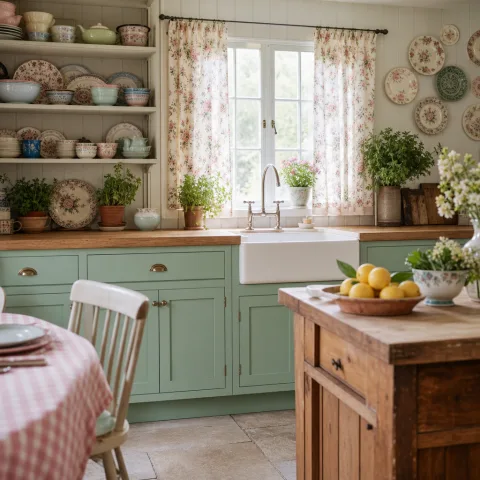
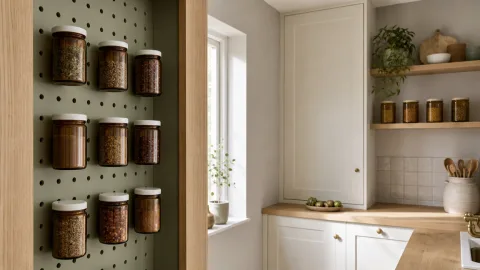
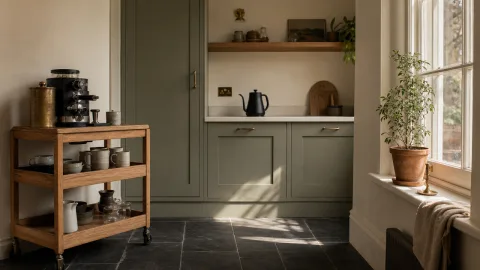
The drawer sits under the butcher block where we chop herbs and prop jars while we strain pasta. It wasn't planned — we put the pruning shears there because we were in the middle of snipping basil and reached for something sharp, then left them where we stood. Over months that pair of shears accumulated neighbors: a small awl that stabs a stubborn wine cork or re-punches a button hole, a roll of butcher’s twine for tying herbs or patching a broken hanger, masking tape for labels and quick seals, a carpenter's pencil for marking, and a tiny steel ruler for measuring the narrowness of a shelf gap. None of these items are culinary by training. They are modest, stubbornly useful things that behave better, functionally and morally, when they live near the stove.
The drawer we stand at
There’s a particular posture that comes with making something in the kitchen: you lean, you prop your elbows on the counter, you forget the time. That is exactly where a handful of small tools should live — in the place where the work and the interruption meet. The drawer we use is narrow, its wood warmed by years of hands and citrus peels, and it opens with a familiar scrape. The contents are not decorative: each item has a dent or a darkened edge that tells its story. Pruning shears have sap in the hinge, the awl’s handle is soft from being held while stubborn things were coaxed, the twine has a knot that looks like a sailor’s secret. They belong to the choreography of the kitchen, the little movements that happen without announcement.
We once tried to relegate these objects to the hall closet — a sensible place, if you believe in systems — but the data was clear: the minute the basil flopped and the twine wasn’t within reach, we improvised with a shoelace and a stack of receipts. Convenience matters, but for us it’s not the same as sloth. We make a practice of keeping the drawer tidy — a ribbon of masking tape folded sticky-side-in, the pencil sharpened to a blunt point, the ruler slid flat. The result is a small ritual that saves time and preserves patience. When we stand at the counter, it is a rarer thing now to mutter and hunt; instead, we reach and fix.
A modest argument for domestic placement
Putting tools where you use them is not lazy; it’s humane. The kitchen is a workshop of glue, food, plants, and seams — an interstitial space where life is currently happening. A pruning shear that lives in a boot tray in the hall might be cleaner, but it’s also out of context. In the kitchen drawer, the shear’s patina is a record of the basil it saved and the stubborn twine it cut for winter preserves. The choice is ethical in a small way: it privileges repair and improvisation over new purchases. We have stopped buying matches we don’t need or gadgets that do one trick because the drawer’s inhabitants already have hands and teeth for more than one small job.
What we resist and why
We resist the piling-in defense: the idea that every problem deserves a new tool. The drawer is intentionally limited to a half-dozen items. Having too many tools in the same small space creates a kind of decision fatigue and invites the acquisition of more 'solutions' rather than the repair of what’s broken. We also resist the aesthetic of perfectly matched stainless-steel sets; uniformity is lovely in a shop catalog but chilling in practice. The tools that make the cut are honest — simple shapes, materials that wear gracefully, function above style. When you keep fewer things that actually work, you end up doing fewer things badly.
Pruning shears: plant work and parcel work
We bought ours at a neighborhood hardware store for twenty euros; they were the cheapest pair that closed cleanly and had a simple locking catch. They started life cutting basil and tomato trusses and soon graduated to cutting twine, trimming stems for jars, and opening stubborn plastic packaging. Pruning shears are bluntly multi-purpose: their pivot acts like a small hand-held guillotine for fibrous things. The trick is to accept them as a hybrid tool and to maintain them as such. We sharpen by hand with a small file twice a season, wipe off sap with a rag and a touch of oil, and keep the pivot screw snug but not immovable. The care is minimal and pays back in neat cuts that don’t bruise a stem or make a mess of twine.
There is a moral hazard, of course: people see sharp things and assume they can replace skill. A clean cut near a plant’s stem matters; a ragged cut invites disease. Similarly, cutting tape or rough cord with shears is efficient but dulls the edge faster. We use a dedicated small pair for plants and a heavier pair for thicker materials. If your kitchen is also where you prune a fiddle leaf or trim parsley every day, a mid-priced pair with a replaceable blade is worth the small expense. Cheap models will serve, but they insist on more attentiveness.
Everyday uses we hadn’t expected
Aside from trimming herbs, the shears have frequently stepped into the role of package opener — cleanly cutting the security straps on a new cast-iron pan — and have been used to cut through the cord of a broken umbrella in a moment of rain-induced panic. They are also, quietly, the best tool we own for snipping the woven tag off a newly thrifted linen napkin without leaving a snag. These incidental uses are the reason we keep them somewhere accessible in the kitchen rather than tucked away in a garden shed. Their presence reduces little frictions that otherwise multiply until the simplest task feels like an episode of improvisation.
Maintenance and a small ritual
We keep a small jar of mineral oil under the sink and wipe the blade after heavy use. Once every few months we loosen the pivot, clean out grit with an old toothbrush, lightly sharpen the bevel with a diamond file, and test on a scrap of cardboard. It takes ten minutes and extends the tool’s life by years. There is a pleasant domesticity to this kind of care; it’s not heroic, it is attentive. If you live in a rental, the ritual also has practical benefits — a well-maintained tool is less likely to stain counters or gum up the drawer, and it’s a small thing you can do to keep your home in shape without making permanent changes.
 Save
Save
The awl: the smallest stubborn problem-solver
The awl is a narrow, pointed thing that feels dramatic for its size. We keep an awl that is little more than three inches of steel with a turned beech handle because it has improbable uses: re-piercing the wax on a cork to ease it out, widening a pilot hole in a wooden spoon so a loose handle can be re-seated with glue, or poking a neat hole through thick cardboard so the grommet can be re-threaded. It isn’t thrilling, but it saves buying a whole new item because a tiny hole refused to exist. For a household that resists disposable mindsets, an awl is a small investment with a series of quiet returns.
The awl’s virtue is that it allows patience to be precise. Instead of brute force — the kind of tearing and prying that leaves a ragged edge — the awl makes a disciplined opening. We use it when a jar’s lid needs a vent to be pried off without disturbing the seal, or when a stubborn tag resists being pulled. There’s also a small pleasure in the tool’s lineage: awls are ancient, they are the toolmakers’ friend, and they remind us that sometimes the neatest work is what happens with the smallest incision.
When not to use an awl
An awl is not a substitute for a drill or a screwdriver. It will not secure screws or make finished holes that hold hardware. It will, however, make a temporary, tidy thing happen: a hole for twine, a vent for a vacuum-sealed lid, a guide where a future screw will go. We avoid using it on brittle ceramics or glass and never force it into material that pushes back with velocity; the tool is too small to be used as a lever. Respecting the awl’s limits keeps it effective and keeps hands out of awkward danger.
A small maintenance note
Keep the awl dry and occasionally rub a thin film of oil on the steel to prevent rust. The handle should be sanded and refinished if it gets gummy from sticky labels or food residues; a coat of beeswax restores grip and looks. We keep ours wrapped in a small square of linen inside the drawer so it doesn’t jab other items — practicality and kindness in one. It’s a small act, but it preserves the tool without turning it into a ritualized chore.
Butcher’s twine: tying, drying, repairing
Butcher’s twine is humble — a coil of unbleached cotton string — but it does work that is disproportionate to its cost. We use it for trussing a roast, yes, but equally for bundling herb stems for drying, tying up a drooping tomato stem against a stake, or fastening a new tag to a plant pot. It’s inexpensive and biodegradable; when it frays, it returns to the compost. There is a patience to twine work that substitutes for the instant solutions a plastic zip tie offers; it looks better, feels better, and can be undone without the crudeness of cutting something away.
We keep a small wooden spool in the drawer and a tidy notch carved into the shelf so the end doesn’t escape as soon as you put it down. Over the years we’ve learned knots that are kitchen-appropriate: a simple clove hitch for holding stems to stakes and a butcher’s knot for trussing poultry. These are not feats of sailorcraft, just useful little techniques. When you tie your herbs correctly they dry flat and usable; when you tie your plants to stakes neatly, you avoid shear damage. Small care here prevents waste later.
Why twine beats tape for some jobs
Masking tape is perfect for labels, but it doesn’t give the same breathing and tender hold that twine does. Twine cinches, distributes pressure, and can be loosened. For drying herbs or tying a bundle of kindling, twine is reversible and leaves no sticky residue. It also resists heat better than many tapes and, importantly, looks better in a linen-wrapped bouquet. For many small domestic tasks, the tactile satisfaction of wrapping string around something is the practical equivalent of choosing to fold your linen instead of stuffing it in a drawer: a small, caring motion.
A note on storage and quantity
A little goes a long way; a single small spool lasts months for two people who garden casually and cook often. Keep it dry and away from oil-splattered zones in the drawer. We avoid plastic-wrapped convenience spools; a wooden bobbin or a recycled cardboard core is less likely to tangle and looks better on a counter. If you find your twine quickly becomes a nest, carve a notch in the drawer lip to hold the end: it’s a tiny hack that saves ten minutes of untangling and a great example of the small decisions that improve daily life.
Masking tape: labels, temporary seals, quick fixes
We favor the paper masking tape over colored packing tape for one crucial reason: it peels cleanly and writes on well. A roll of tape sits in the drawer folded around itself so the end is easy to find; a stub of pencil is usually tucked in the loop. In practical terms, masking tape labels jars, holds a torn pie crust while it’s patched, and seals a bag of dried mushrooms for the refrigerator. It’s temporary, which is its point. You put the tape on for a reason and take it off when the job is done, and that temporariness trains you to be less acquisitive and more deliberate.
There is also an aesthetic argument: masking tape’s matte, fibrous look matches the textures of linen and wood and reads as intentional rather than slapdash. If you tape a label on a jar of preserved lemons and later peel it off, the glass remains unscarred. This is the small cruelty-avoidance of the drawer: choose tools and materials that don’t insist on violence with surfaces. Masking tape also has surprising structural uses — wrapped around a handle to temporarily improve grip, or bridging a tear in canvas to make a small patch point to where repair is needed.
A kitchen etiquette for tape
Treat tape as a temporary accessory, not a permanent solution. If you find yourself using it to patch a drawer bottom or permanently hold a handle, consider a small repair that will last: a drop of PVA glue, a screw, or a piece of twine might be the better option. The tape’s job in the kitchen is to be the stopgap that allows you to delay or avoid unnecessary replacements. We keep only one roll in the drawer at a time and replace it when it gets too gummy; this modest discipline keeps the drawer from becoming a tape graveyard.
Masking tape and rented places
We’ve used masking tape in a rental to gently label paint samples on a wall without scoring the plaster. It’s a renter’s friend because it allows temporary experiments without commitment. If you are marking a line for a hanging, tape supports the pencil and then peels away without pulling paint. That said, avoid leaving tape on painted surfaces for months; even the nicest paper tape can oxidize and leave a residue. Short-term use and prompt removal keep both your landlord and your conscience happy.
The pencil and tiny ruler: measure twice, mark once
We keep a short carpenter’s pencil that won’t roll and a six-inch steel ruler because kitchens are full of narrow decisions: will this jar fit on the top shelf? How straight is that shelf bracket? A pencil with a blunt, reliable point and a compact ruler let us mark and test without committing to large tools. The carpenter’s pencil’s flat profile is less likely to fall behind the counter; its stubby length makes it less delicate and therefore more likely to be used. The steel ruler is precise, tamper-resistant, and has the honesty of metal — it doesn’t pretend.
A short routine with these tools has saved us from awkward returns. Before we bought a new spice rack we slid the ruler into its proposed slot and used the pencil to mark a tiny notch where the shelf lip would need trimming; it was a five-minute intervention that kept us from ordering the wrong size. The pencil is also indispensable for labeling jars when masking tape is too large for the cap. These small decisions add up; measuring in the kitchen is not a show of perfectionism but rather a way to keep things working and affordable.
Marking in a kitchen — small etiquette
Keep pencil marks light and erase them if they are on visible surfaces. Prefer the inside face of a cabinet or the underside of a shelf for permanent reference marks. If you live in a rental, communicate with your landlord about permanent alterations; many landlords appreciate careful notes and small fixes more than unexpected holes. A small set of measurements written on a scrap of paper and taped inside a drawer is a low-friction way to keep track of dimensions without marring the plaster.
Why cheap and blunt tools are often better
A blunt pencil resists over-precision and invites practical marks; a delicate mechanical pencil encourages fine line anxiety that the kitchen does not need. Similarly, a small steel ruler is robust and honest, less prone to bending than a plastic one. We prefer tools that are forgiving and that signal their own limits — they reduce the impulse to overreach. This is the contrarian part of our approach: we are pro-mend and anti-gadget. The right bluntness keeps domestic life moving forward without theatrics.
 Save
Save
How we keep them clean, safe, and ready
There is an etiquette to keeping non-kitchen tools in a food space: cleanliness matters, and boundaries matter. We keep a small cotton rag folded in the drawer for wiping sticky blades, a jam jar to hold small metal bits during a repair, and a thin strip of silicon to rest the awl so it doesn’t pierce the wood. Heavy-duty items that will touch raw meat or soil belong elsewhere, but light work tools that come into contact with herbs or packaging are fine if they are wiped and stored dry. The point is not to exclude but to integrate with thoughtfulness.
We also have a small rule about contamination: if a tool is used with soil or raw meat, it gets a specific cleaning routine and a temporary quarantine. For soil, a brush and warm water; for meat, a scrub with a little detergent and full drying. Nothing is more discouraging than reaching for the shears and finding sap and soil smeared across your basil. This tidy attention takes a few minutes and prevents the substitution of hygiene for disposability. It’s easier to keep a tool than to keep buying replacements.
Child and guest safety
We live in a small rental and often have friends over; for that reason we keep sharp points covered. The awl and shears sit in a small cloth pouch; masking tape and ruler are laid flat; the twine is wound into a tidy coil. If you have children, add small locks or keep the drawer higher. The point of accessibility is not recklessness — it’s a calibrated convenience. Guests are often surprised by the drawer’s contents, but they are less surprised by how useful those contents are when a plant needs tying or a jar needs a label.
A simple ordering system
Our ordering system is: sharp things wrapped, small things nested, consumables visible. That means a small cloth for the awl, a tiny metal tray for the shears, and the twine on a little spindle so the end is never lost. We periodically audit: if something hasn't been used in six months, it moves to long-term storage or gets given away. The drawer’s discipline keeps the tools hungry for work rather than accumulating dust. Curate, don’t hoard — this is a house-rule as much as it is a domestic philosophy.
A small packing list and the only rules we follow
If you wanted to build your own drawer like ours, these are the six items and why each earns a permanent place: pruning shears for clean cutting, a small awl for precise punctures, butcher’s twine for tying and drying, masking tape for short-term labels and fixes, a carpenter’s pencil for marks, and a tiny steel ruler for measuring tight spaces. Each item is inexpensive, repairable, and versatile. The rules we keep are small: one, keep tools where you use them; two, maintain them; three, limit the quantity. These constraints make choices cheap and reversible.
A small list helps avoid the slippery slope of acquisitiveness. We have resisted gadgets that promise to 'do it all' because they rarely do and often replace multiple small tools with a plastic, single-use mechanism. The drawer’s six items perform many tasks well enough that the impulse to buy another tool is quelled. This is not an argument against buying things, it’s an argument for buying thoughtfully: choose something well-made when you do buy, and prefer repair over replacement when you can.
- Pruning shears — look for a clean cut and a simple lock.
- Small awl — a turned wooden handle and a short, sturdy point.
- Butcher’s twine — unbleached cotton on a small spool.
- Masking tape — paper tape that peels cleanly.
- Carpenter’s pencil — blunt, short, no rolling.
- Six-inch steel ruler — compact and true.
“Keep the tools where you stand; the smallest decisions are often the most humane.” — Mira and Theo
 Save
Save
How the drawer changes the way we cook
There’s a subtle behavioral change when you know a helpful thing is within reach. We find we attempt fewer heroic improvisations because small fixes are cheap and visible. That means fewer substitutes that produce mediocre results and more willingness to see a task through — tying a leg of lamb properly, trimming a plant stem neatly, or hacking a temporary hanging with twine and tape until we make a better plan. The drawer fosters restraint; it nudges a kind of slow competence into everyday life.
It also affects hosting. A guest will notice a twine-and-tape-labeled jar and feel that someone has paid attention. The small tools allow for hospitality that is practical rather than performative. For example, when we host a casual dinner we’re less likely to be flustered by a stubborn cork or a jar that needs a makeshift tag; the drawer reduces the friction between intention and execution. Good hosting, like good cooking, is mostly about making small things right so the rest can breathe.
A reminder about limits
The drawer isn’t a magic fix for structural problems. If a cabinet is falling apart you need a small repair or a craftsman, not a roll of tape and a hopeful knot. The drawer is about everyday frictions, not replacement-level problems. Keep perspective: these six tools are an invitation to attempt small repairs, not a promise to do everything. When a job exceeds the drawer’s capabilities, call someone who can do it properly. That restraint keeps the drawer useful rather than dishonest.
A drawer as a way of caring
Tools in a kitchen drawer are gestures of care. They say: we will try to keep this thing alive; we will attempt the small repair before buying a replacement. Keeping the awl oiled and the twine tidy is a daily kindness to objects and to the people who use them. It is a quiet refusal of the culture that encourages throwing things away at the first sign of wear. In practice, these investments are modest — a three-euro spool, a twenty-euro pair of shears — but the ethos behind them is generous and sustaining.
There’s also a social element: friends borrow our shear and return it sharpened; a neighbor taught us a knot for tying basil; we loan the awl and get back a repaired wooden spoon. The drawer is a small public commons in a dense city: you loan, you receive, you learn. It changes the rhythm of living from solitary consumption to cooperative maintenance. In a 740-square-foot rental, these small collaborations are how communities of care manifest in material form.
 Save
Save
Final small rules before you curate your own drawer
Be ruthless about duplicates. Two tape rolls, three pairs of scissors, a forest of random kitchen implements — these clutter thinking and space. Choose one or two versions of a tool that meet your real needs and remove the rest. Second, prefer materials that age kindly: wood, simple metal, cotton twine. Third, test a tool before buying: a cheap shear might work for a season but cost you attention; a slightly better pair will ask for nothing more than a file and an oil rag. These rules keep the drawer small and honest.
Start with the six we recommend and live with them for three months. You’ll learn what truly matters and what was merely aspirational. Replace with care, not haste. A tool that sits unused for months likely doesn’t belong in the drawer; a tool you reach for daily deserves a better place. Curating a drawer is less about the things and more about the shape of your days: where interruptions occur, what you value, and how ready you want to be when small problems arrive.
How to do it
Gather the six essentials
Collect pruning shears, a small awl, a spool of butcher’s twine, a roll of masking tape, a carpenter’s pencil, and a six-inch steel ruler into one spot so you can see how they fit together.
Design a simple layout
Decide where each item will live in the drawer so you can reach without rummaging — shears in a small tray, twine on a spindle, pencil and ruler flat in a corner.
Set a maintenance habit
Once a month wipe sticky residues, oil metal briefly, and tighten pivots; if something hasn’t been used in six months, move it out.
Frequently asked
Won’t having non-food tools in the kitchen make things unhygienic?
What if I live in a rental and my landlord objects to tools in the kitchen?
Can pruning shears really be used for packaging and plants without dulling quickly?
How many rolls of tape or spools of twine should I keep?
In closing
The rule we live by is simple: put the things where you are when the need happens. A drawer of odd tools is not an exhibition of thriftiness or an argument for hording; it’s a small, deliberate rehearsal in being prepared without fuss. Keep what you reach for most, and be ruthless about the rest — a single drawer should be a curated toolkit, not a shed. When the awl has a clean edge, the twine a neat knot, the shears a sharpened mouth, the drawer becomes less a container and more a companion. That matters because domestic life is mostly small interruptions: a stubborn cork, a tomato plant that needs its stem tied, a box that needs a measured strip cut free. The drawer is where we answer those interruptions, quietly and with tools that have nothing to do with cooking and everything to do with staying in the service of living well.