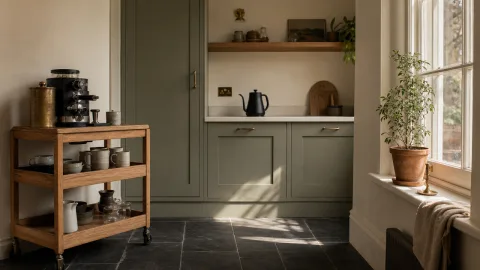
North-facing kitchens are an architectural test of patience. Our flat had one with three good things — pine floors, a deep porcelain sink, a window that opened onto a courtyard — and one bad thing, which was the light. Until November the kitchen read as cold no matter what we put in it. Then we hung a thrifted linen panel an inch above the rod, and the room found a glow that has never left it since.
Why the rod height matters more than the curtain
Most curtains are hung directly on the rod. The rod sits at the top of the window frame. The curtain pools at the floor. This is the standard, and it is wrong for any room you want to feel taller. Hang the rod two centimetres above the frame, hang the curtain one centimetre above the rod, and the eye reads the entire wall as the window. The kitchen feels half a metre taller. Nothing about the curtain has changed.
 Save
Save
There is a corollary that nobody mentions. A north-facing window is fundamentally cold light. Linen — natural, unbleached, with that faint oat tone — warms the light by perhaps two degrees on the colour wheel. Synthetic curtain panels do the opposite. They cool the light, fade it, and read as plastic. The difference is visible to the naked eye on the first morning.
What we found in Coimbra
The panel cost fourteen euros at the Mercado Municipal in Coimbra on a wet October Sunday. It had been someone's bedroom curtain — there was a faint stain along one edge that washed out with cold water and a pinch of soap. The colour was the colour of weak chamomile tea. It hung, on the way home in a backpack, like a heavy linen cloth, which it was.
 Save
Save
“Linen warms north light by perhaps two degrees on the colour wheel. Synthetic does the opposite — it reads as plastic.” — Mira
Hanging it
We bought a length of birch dowel from a hardware store, sanded it to 320 grit, oiled it with a single coat of beeswax, and hung it on two brass cup hooks driven into the lintel above the window frame. Total cost, including the curtain, was twenty euros. We hand-stitched eight cotton tape loops along the top edge of the panel and threaded the dowel through them. The panel hangs an inch proud of the rod and falls a thumb's width above the floor.
- Buy second-hand. Old linen has been through a hundred wash cycles. New linen has not.
- Length matters. Floor-pooling reads as bedroom; floor-grazing reads as kitchen. A thumb's width above is the rule.
- Hand-stitch your own loops or tabs. Pleats look fussy on a kitchen window. Loops are honest.
- A wooden rod beats a metal one for warmth. Brass cup hooks beat brackets — invisible from outside, easy to remove.
How to do it
Wash before measuring.
Cold water, line dry. Linen shrinks 4–6% on the first wash. Measure after, not before, or your floor-grazing curtain becomes a floor-skipping one.

Hang the rod two cm above the frame.
Mark with a pencil and a spirit level. Drive cup hooks at each mark. The rod sits in the hooks — no brackets, no screws into the lintel above eye level.
Stitch eight loops.
Cotton tape, four centimetres long, folded in half, sewn flat along the top edge of the panel — eight loops on a window of average width, ten on something tall. Spacing is felt, not measured.
Hang the panel one cm above the rod.
Bunch the loops slightly so the panel sits just above the rod, not under it. The eye reads the rod as part of the curtain, not separate. This is where the height illusion comes from.
Frequently asked
What weight of linen should I look for?
Can I do this in a rental?
What if my window is wider than a single panel?
How often do I wash it?
In closing
The curtain has been up for eighteen months. The kitchen no longer reads as cold. The light through linen at eight in the morning is the kind of detail that you do not notice until it is gone — and then, three days later, you realise the room has stopped feeling like a kitchen. It became a place to be in. That was the curtain.